Open the annual report of many large PSX companies and you'll find two sets of financial statements: unconsolidated and consolidated. They can show very different profits. Here's what each means and which one to read.
A family business example
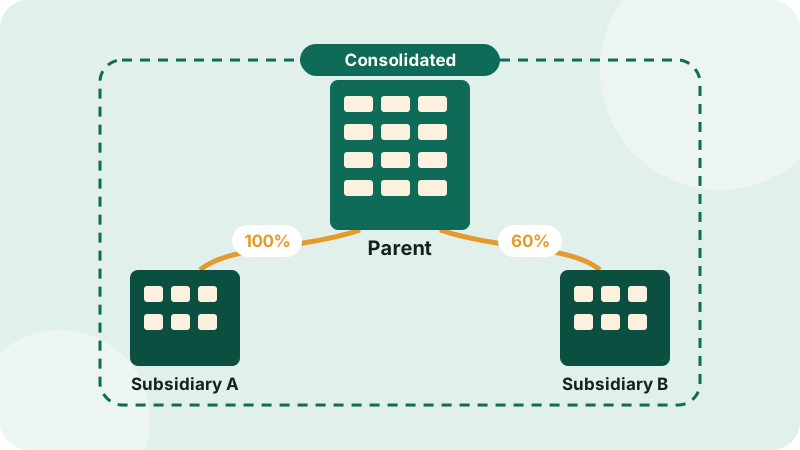
Mr. Ahmed owns a main company that runs a factory. That company also owns:
- 100% of a transport company that delivers its goods, and
- 60% of a packaging company (a partner owns the other 40%).
Looking only at the main company's own books gives the unconsolidated picture. Adding up all three companies as if they were one big business gives the consolidated picture.
Key terms
- Parent (holding) company: the company that owns and controls others. Its shares are the ones listed on the PSX.
- Subsidiary: a company controlled by the parent, usually by owning more than 50% of its shares.
- Unconsolidated (standalone) statements: the parent company alone. Its investments in subsidiaries appear as a single "long-term investment" line, and it records only the dividends the subsidiaries pay it.
- Consolidated statements: the parent and all subsidiaries combined line by line, as one economic group.
- Non-controlling interest (NCI): the share of a subsidiary owned by outsiders (the 40% partner in our example).
Worked example
Sitara Holdings Ltd (fictional) has 100 million shares. This year's profits:
| Sitara Holdings (parent alone) | Rs 300 million |
| Subsidiary A, 100% owned | Rs 100 million |
| Subsidiary B, 60% owned | Rs 50 million |
| Less: profit on goods the parent sold to A that are still unsold in A's warehouse | − Rs 10 million |
| Consolidated profit | Rs 440 million |
| Less: share of outside owners of B (40% × 50) | − Rs 20 million |
| Profit attributable to owners of the parent | Rs 420 million |
- Unconsolidated EPS = 300 ÷ 100 = Rs 3.00
- Consolidated EPS = 420 ÷ 100 = Rs 4.20
Why remove the Rs 10 million? Because selling goods from one group company to another is like moving money from your left pocket to your right: the group hasn't earned anything until the goods are sold to an outside customer. Consolidation removes these internal sales, profits, debts and dividends.
Which one should you read?
- To judge the whole business (total sales, total debt, overall profitability, P/E ratio): use the consolidated statements and the EPS "attributable to owners of the parent".
- To understand dividends: dividends are declared by the parent from its own (unconsolidated) distributable profits, so the standalone statements matter too.
- If a company has no subsidiaries, it publishes only one set, simply called its financial statements.
Financial websites sometimes quote one EPS and sometimes the other, which is why two sites can show different numbers for the same company. Always check which one is being used.
Red flags
- Parent profitable, group making losses: subsidiaries may be draining money.
- Debt much higher in consolidated statements: borrowing may be sitting in subsidiaries.
- Large dealings between related companies: read the "related party transactions" note carefully.