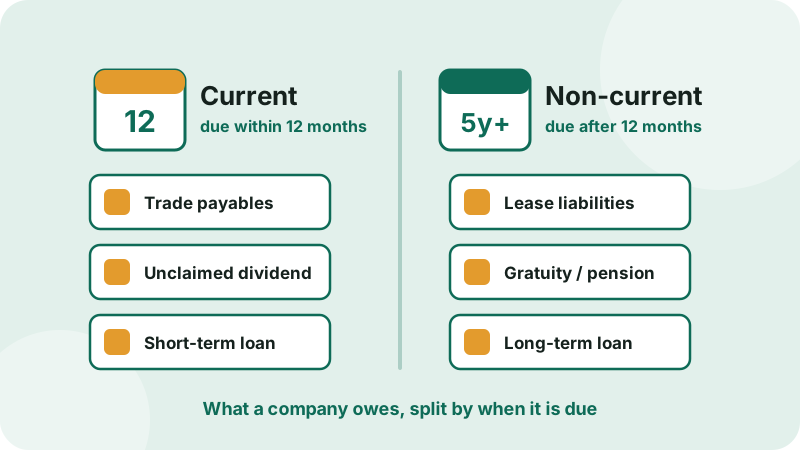
Every company owes money to someone: banks, suppliers, landlords, employees, even its own shareholders. In the balance sheet (statement of financial position), these debts are called liabilities, and they are split into two groups depending on when they must be paid.
A household example
Think of your own family's debts:
- This month's electricity bill, the grocer's credit and next month's school fee must be paid soon. These are like current liabilities.
- A 10-year home loan or a 5-year car loan will be paid off over many years. These are like non-current liabilities.
The part of the car loan you must pay this year is current; the rest is non-current.
The 12-month rule
Non-current liability = due after 12 months
That's the whole idea. The same loan can appear in both groups: the instalments due in the next year are shown as "current portion of long-term financing", and the rest as long-term financing.
Non-current liabilities you will see
1. Lease liabilities
When a company rents a shop, office, warehouse or vehicle for several years, accounting rules (IFRS 16) treat the rent agreement almost like a loan. The company records a lease liability: the value of all the future rent it has promised to pay.
Example: a company signs a 5-year lease for a showroom at Rs 1 million a year. It records a lease liability of slightly less than Rs 5 million (future payments are discounted to today's value). The rent due in the next 12 months is shown under current liabilities as "current portion of lease liabilities"; the remaining years are non-current.
2. Employee retirement benefits
Many Pakistani companies promise employees a gratuity or pension when they leave or retire. The company owes this money a little more every year an employee works, so it records it as a liability now, even though the payment comes later. In reports it often appears as "Deferred liabilities – staff retirement benefits" or "Employee benefit obligations".
Example: an employee earns Rs 100,000 a month and gets one month's salary as gratuity for each year of service. After 10 years, the company owes about Rs 1,000,000. It records this gradually as a liability year by year, using estimates by an actuary.
Others
- Long-term financing: bank loans repayable over several years.
- Deferred tax liability: tax that will become payable in future years because of timing differences in accounting.
Current liabilities you will see
1. Trade and other payables
Money the company owes to suppliers for goods and services bought on credit, plus other short-term amounts such as accrued expenses, advances from customers and payable taxes. This is usually the biggest current liability.
Example: a textile mill buys cotton worth Rs 50 million on 60 days' credit. Until it pays, that Rs 50 million sits in trade payables.
2. Unclaimed dividend
Sometimes a company announces a dividend but some shareholders never receive it, for example because their bank details are missing or out of date, or a shareholder has died and heirs haven't claimed it. The company still owes this money, so it shows it as unclaimed dividend (sometimes "unpaid dividend"). Under the Companies Act 2017, dividends that stay unclaimed for a long period must, after notices, be deposited with the government, so shareholders should keep their bank details updated with their broker or share registrar.
Others
- Short-term borrowings: running finance and other bank loans due within a year.
- Accrued mark-up: interest that is due but not yet paid.
- Current portion of long-term financing and lease liabilities.
- Taxation: income tax payable.
Worked example: a simple balance sheet
Ravi Textiles Ltd (fictional), figures in Rs million:
| Non-current liabilities | Rs m |
|---|---|
| Long-term financing | 400 |
| Lease liabilities | 60 |
| Staff retirement benefits | 90 |
| Deferred tax | 50 |
| Total non-current | 600 |
| Current liabilities | Rs m |
|---|---|
| Trade and other payables | 350 |
| Unclaimed dividend | 5 |
| Accrued mark-up | 15 |
| Short-term borrowings | 200 |
| Current portion of long-term financing | 80 |
| Current portion of lease liabilities | 20 |
| Taxation | 30 |
| Total current | 700 |
Ravi Textiles owes Rs 1,300 million in total, and Rs 700 million of that must be paid within a year.
Why the split matters
Investors compare current liabilities with current assets (cash, stock and money customers owe) to see whether the company can pay its short-term bills:
If Ravi Textiles has current assets of Rs 900 million, its current ratio is 900 ÷ 700 = 1.29. Above 1 means it has more short-term assets than short-term debts. A ratio well below 1 can signal cash pressure.
- Rising short-term borrowings year after year may mean the company is borrowing to survive.
- Large retirement benefit obligations are a future cash commitment worth noting.
- Growing lease liabilities often mean the company is opening more branches or outlets.