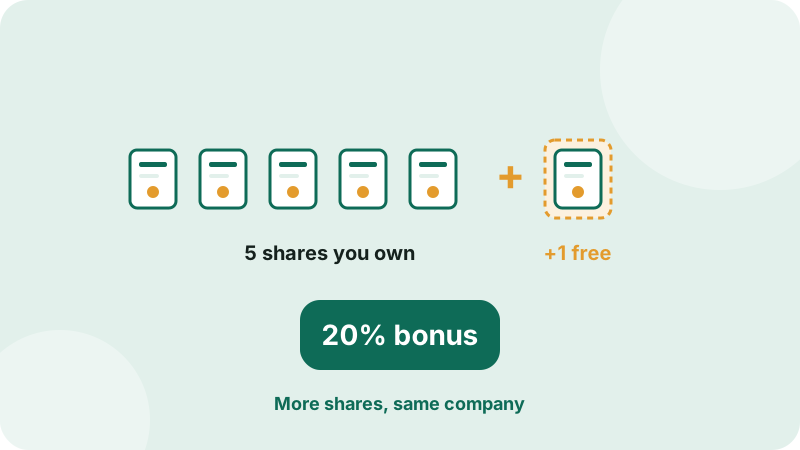
Some PSX companies announce a "bonus issue" or "stock dividend" instead of, or together with, a cash dividend. Many new investors think they are getting free money. You do get more shares, but as this guide shows, your total wealth doesn't change on the day.
What is a stock dividend?
A stock dividend, called a bonus issue or bonus shares in Pakistan, is when a company gives existing shareholders additional shares for free, in proportion to what they already own. The company doesn't pay out any cash. Instead, it moves part of its accumulated profits (reserves) into share capital.
A simple analogy
You have a pizza cut into 4 slices and you own all of it. Someone cuts it into 8 slices. You now have twice as many slices, but exactly the same amount of pizza.
Bonus shares work the same way: more pieces, same company.
What does a "20% bonus" mean?
Bonus issues are announced as a percentage of shares held:
- 20% bonus = 1 new share for every 5 held
- 10% bonus = 1 for every 10
- 25% bonus = 1 for every 4
Worked example
You own 500 shares of Noor Cement Ltd (fictional) at Rs 100 each. Your holding is worth Rs 50,000. The company announces a 20% bonus.
- New shares: 500 × 20% = 100, so you now own 600 shares.
- On the ex-bonus date, the price adjusts to about 100 ÷ 1.20 = Rs 83.33.
- Your holding: 600 × 83.33 = about Rs 50,000, the same as before.
Over time, the share price moves with the company's performance and the market, but the bonus itself doesn't create value on the day.
Effect on EPS
Noor Cement earns Rs 600 million with 60 million shares: EPS = Rs 10.
After a 20% bonus, it has 72 million shares. Same profit: EPS = 600 ÷ 72 = Rs 8.33.
When comparing EPS across years, use figures adjusted for bonus issues. Companies restate the previous year's EPS in their reports to make the comparison fair.
What about fractions?
If you own 105 shares and the company announces a 15% bonus, your entitlement is 15.75 shares. You receive 15 whole shares; fractional entitlements are usually combined, sold by the company, and the cash is distributed to the shareholders concerned.
Stock dividend vs cash dividend
| Cash dividend | Stock dividend (bonus) | |
|---|---|---|
| What you receive | Money in your bank account | Extra shares |
| Company's cash | Goes down | Unchanged |
| Number of shares | Unchanged | Increases |
| Share price on ex-date | Drops by about the dividend | Adjusts by the bonus ratio |
| Your total value on the day | About the same in both cases | |
See our guide to cash dividends and dividend yield.
Why companies issue bonus shares
- To keep cash in the business for expansion or debt repayment, while still rewarding shareholders.
- To lower the share price per unit, making shares more affordable and easier to trade.
- To signal confidence: management expects to keep earning on a larger share base.
Things to keep in mind
- Future cash dividends: if the company keeps paying the same rupee dividend per share, you now receive it on more shares.
- Tax: the tax treatment of bonus shares in Pakistan has changed over the years, so check the current rules with your broker or FBR.
- Entitlement: you must hold the shares before the book closure / ex-bonus date to receive the bonus.