A company can report a big profit and still run out of money. That sounds strange, but it happens because profit is not the same as cash. Operating cash flow shows the real cash a business brings in from its everyday work, which is why many experienced investors check it before anything else.
Why profit and cash are different
A wholesaler sells goods worth Rs 10 lakh to shopkeepers in March, on 3 months' credit. In its accounts, the sale counts in March and adds to profit immediately.
But the cash only arrives in June, and only if the shopkeepers actually pay. Until then, the wholesaler has "profit" on paper but no cash to pay salaries or suppliers.
Operating cash flow fixes this by tracking the money that truly came in and went out.
Operating cash flow formula
Companies usually start from profit and adjust it (this is called the indirect method):
- Depreciation is added back because it reduces profit but no cash leaves the company.
- Higher receivables reduce cash: customers owe more money that hasn't been collected.
- Higher inventory reduces cash: money is tied up in stock sitting in the warehouse.
- Higher payables increase cash: the company hasn't paid its own suppliers yet.
Worked example
Indus Traders Ltd (a fictional company) this year:
| Net profit | Rs 100 million |
| + Depreciation | + 20 million |
| − Increase in receivables | − 50 million |
| − Increase in inventory | − 30 million |
| + Increase in payables | + 10 million |
| Operating cash flow | Rs 50 million |
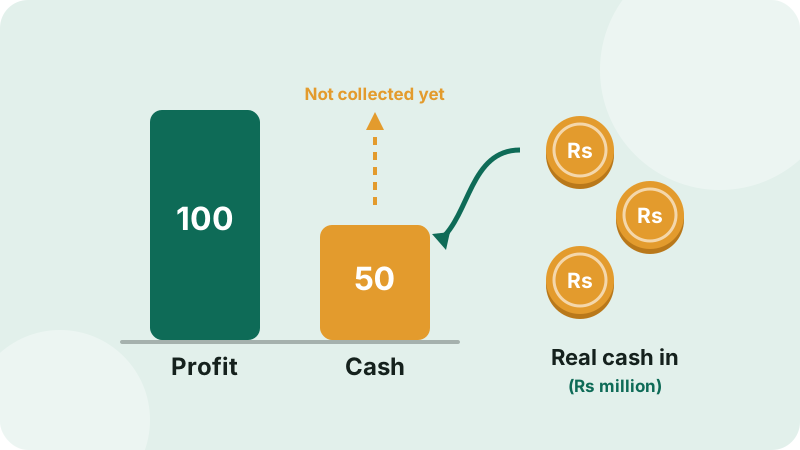
Indus Traders reported Rs 100 million profit, but only Rs 50 million arrived as cash, mostly because customers haven't paid and stock has piled up.
The three parts of a cash flow statement
- Operating activities: cash from the main business (selling goods and services, paying staff and suppliers). This is the most important part.
- Investing activities: cash spent on or received from long-term assets, such as buying machinery or selling land.
- Financing activities: cash from loans, issuing shares, repaying debt and paying dividends.
In Pakistani company reports, look for the statement of cash flows and the line "Net cash generated from / (used in) operating activities".
Warning signs to watch
- Profit rising but operating cash flow negative for several years: the company may be booking sales it struggles to collect.
- Receivables growing much faster than sales: customers are taking longer to pay.
- Dividends paid from loans rather than from operating cash: not sustainable.
A healthy company usually has operating cash flow close to, or higher than, its net profit over a few years.
Free cash flow
Capital expenditure is money spent on new machinery, buildings and equipment. What is left, the free cash flow, is the cash available to pay dividends, reduce debt or expand. If Indus Traders spends Rs 30 million on new machinery, its free cash flow is Rs 50 − 30 = Rs 20 million.