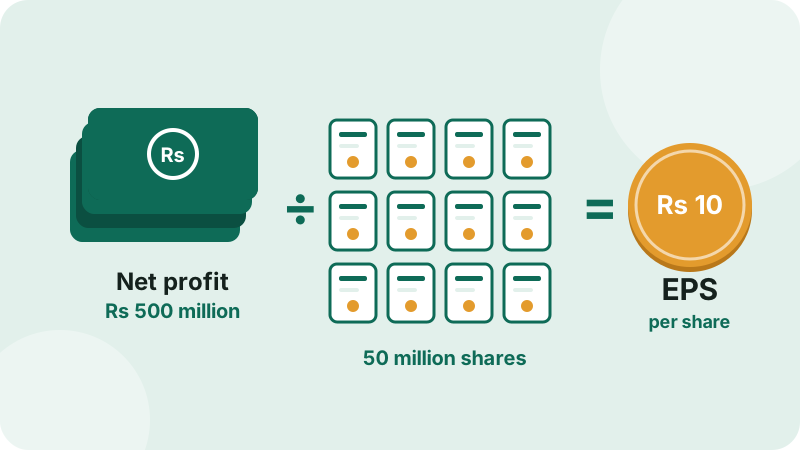
When a company announces its results on the Pakistan Stock Exchange (PSX), one of the first numbers investors look at is EPS, or earnings per share. It answers a simple question: if the company's profit were divided equally among all its shares, how much would each share get?
EPS meaning in simple words
Imagine a small shop owned by 10 partners, each holding one share. If the shop makes a profit of Rs 100,000 this year, each share "earned" Rs 10,000. That Rs 10,000 is the earnings per share.
A listed company works the same way, only with millions of shares. EPS shows how much of the company's profit belongs to each single share you hold.
EPS formula
Most companies have no preference shares, so for them it is simply net profit ÷ number of shares. Companies use the weighted average number of shares for the year, which accounts for any new shares issued during the year.
Worked example
Sitara Foods Ltd (a fictional company) reports:
- Net profit after tax: Rs 500 million
- Number of shares: 50 million
EPS = Rs 500,000,000 ÷ 50,000,000 = Rs 10 per share
So every share of Sitara Foods earned Rs 10 of profit this year.
Why EPS matters
A single year's EPS tells you little. The real value is in the trend. Look at Sitara Foods over three years:
| Year | Net profit (Rs million) | EPS (Rs) |
|---|---|---|
| 2023 | 325 | 6.50 |
| 2024 | 400 | 8.00 |
| 2025 | 500 | 10.00 |
EPS grew from Rs 6.50 to Rs 10 in two years, about 24% a year. Steady growth like this usually means the business is expanding. Falling EPS year after year is a warning sign worth investigating.
Basic EPS vs diluted EPS
- Basic EPS uses the shares that exist today.
- Diluted EPS also counts shares that could be created in future, for example from convertible bonds or employee share options. It is usually equal to or slightly lower than basic EPS.
If the two numbers are very different, more shares may be issued in future, which would spread the profit across more shares.
Where to find EPS for a PSX company
Open the company's quarterly or annual report and go to the statement of profit or loss (income statement). At the very bottom you will see a line such as "Earnings per share – basic and diluted (Rupees)". Quarterly reports show EPS for the quarter and for the year so far.
Limitations of EPS
- Don't compare raw EPS between companies. A company with an EPS of Rs 50 is not automatically better than one with Rs 5; they have different share prices and numbers of shares. Use the P/E ratio to compare.
- One-off gains can inflate EPS. Selling a building or a big currency gain can boost profit for one year only. Read the notes to see where the profit came from.
- Profit is not cash. A company can show high EPS while struggling to collect cash. Check its operating cash flow too.