Is a share priced at Rs 300 more expensive than one priced at Rs 50? Not necessarily. The share price alone tells you nothing about value. The P/E ratio (price-to-earnings ratio) is the most widely used way to judge whether a share is cheap or expensive compared with the profit it earns.
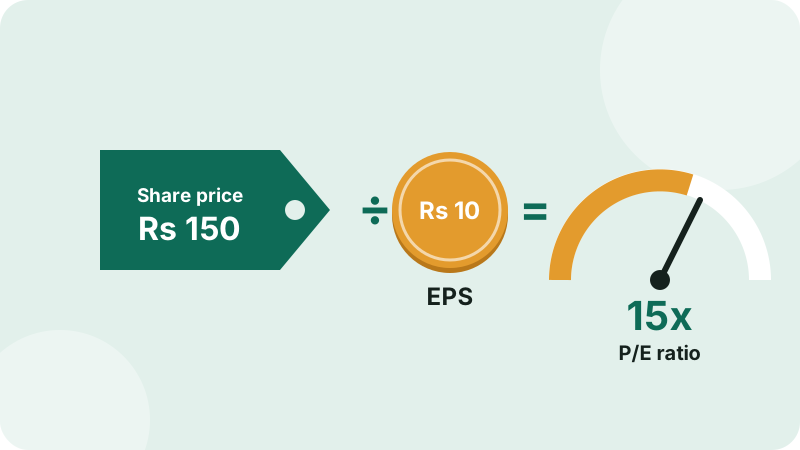
P/E ratio formula
If you are not familiar with EPS, read What is EPS? first.
Worked example
Sitara Foods Ltd (fictional) has an EPS of Rs 10 and its share trades at Rs 150.
P/E = 150 ÷ 10 = 15 times (written 15x)
This means investors are paying Rs 15 for every Rs 1 of yearly profit. Put another way, if profits stayed the same, it would take about 15 years of earnings to equal the price you paid.
What does a high or low P/E mean?
- Low P/E (for example 4x–6x): the share may be undervalued, or investors may expect profits to fall, or the company may have risks such as high debt or problems in its sector.
- High P/E (for example 20x or more): investors expect strong future growth and are willing to pay more today. If that growth doesn't come, the share price can fall sharply.
So a low P/E is not automatically a bargain, and a high P/E is not automatically overpriced. It is a starting point for asking why.
Compare P/E within the same sector
Different industries naturally trade at different P/E levels: fast-growing technology companies often have higher P/E ratios than banks or cement companies. Compare companies that do similar business:
| Company (fictional) | Share price (Rs) | EPS (Rs) | P/E |
|---|---|---|---|
| Noor Cement | 90 | 15 | 6.0x |
| Karakoram Cement | 120 | 12 | 10.0x |
| Ravi Cement | 60 | 4 | 15.0x |
Noor Cement looks the cheapest on P/E. The next step is to find out why: is it genuinely undervalued, or does it have more debt, older plants or falling sales?
Trailing P/E vs forward P/E
- Trailing P/E uses the EPS of the last 12 months (actual results).
- Forward P/E uses the EPS analysts expect for the next 12 months (an estimate).
Trailing P/E is based on facts; forward P/E depends on forecasts that may turn out wrong.
Earnings yield: the P/E turned upside down
For Sitara Foods: 10 ÷ 150 × 100 = 6.7%. Earnings yield makes it easy to compare a share with other options such as bank profit rates or savings certificates.
Common mistakes with P/E
- Comparing across different sectors, such as a bank with a technology company.
- Ignoring one-off profits: a one-time gain lowers P/E for a year and makes the share look cheaper than it is.
- Using P/E for loss-making companies: if EPS is negative, P/E is not meaningful.
- Relying on P/E alone: also check debt, cash flow and growth.