"Equity" is one of the most common words in finance, and it can mean two related things. In the stock market, equities simply means shares. In a company's accounts, shareholders' equity means the part of the company that truly belongs to its owners. This article explains the second meaning, which is the one you see in a balance sheet.
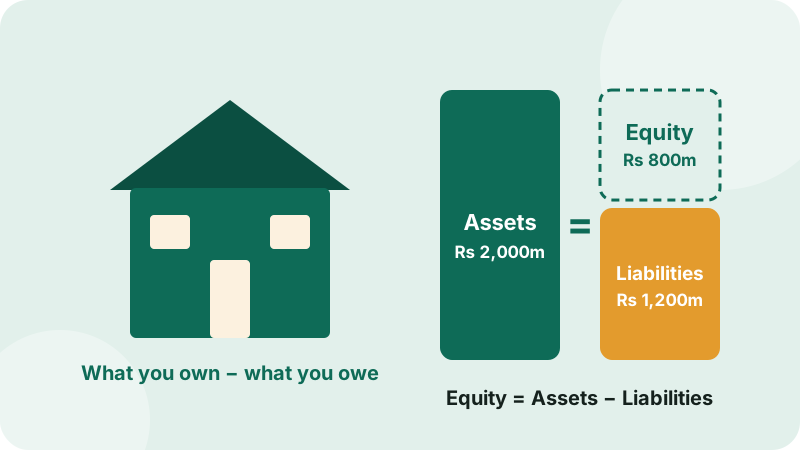
Equity explained with a house
Suppose you own a house worth Rs 1 crore, but you still owe the bank Rs 40 lakh on your home loan.
If you sold the house today and paid off the loan, you would keep Rs 60 lakh. That Rs 60 lakh is your equity in the house.
A company works exactly the same way: equity is what would be left for shareholders if the company sold everything it owns and paid all its debts.
Equity formula
- Assets are what the company owns: factories, machinery, inventory, cash, money customers owe it.
- Liabilities are what it owes: bank loans, money owed to suppliers, taxes payable.
Worked example
Noor Cement Ltd (a fictional company) has:
- Total assets: Rs 2,000 million
- Total liabilities: Rs 1,200 million
- Number of shares: 40 million
Equity = 2,000 − 1,200 = Rs 800 million
Book value per share = 800,000,000 ÷ 40,000,000 = Rs 20 per share
Book value per share is the accounting value of each share. If Noor Cement's share trades at Rs 30, investors are paying more than book value, usually because they expect future profits.
What makes up equity
In the balance sheet of a Pakistani company, equity usually includes:
- Share capital: the money originally raised by issuing shares (usually at a face value of Rs 10 each).
- Share premium: extra money received when shares were issued above face value.
- Reserves / unappropriated profit: profits the company has kept over the years instead of paying out as dividends. This is often the largest part.
- Revaluation surplus: an increase in the value of assets such as land after revaluation.
Why equity matters to investors
- Growing equity is a good sign. If equity rises every year, the company is making profits and keeping some of them to grow.
- It shows financial strength. A company with high equity and low debt can survive hard times more easily.
- It is used in key ratios, such as Return on Equity (profit ÷ equity), which shows how well management uses shareholders' money, and debt-to-equity (debt ÷ equity), which shows how much the company relies on loans.
Negative equity: a warning sign
If a company's liabilities are larger than its assets, its equity is negative. This usually happens after years of losses. It means that, on paper, shareholders would get nothing if the company closed. Be very careful with such companies.
Equity vs market capitalization
Equity is the accounting value from the balance sheet. Market capitalization is the share price multiplied by the number of shares: what the market is willing to pay today. A profitable, growing company usually has a market capitalization well above its equity.