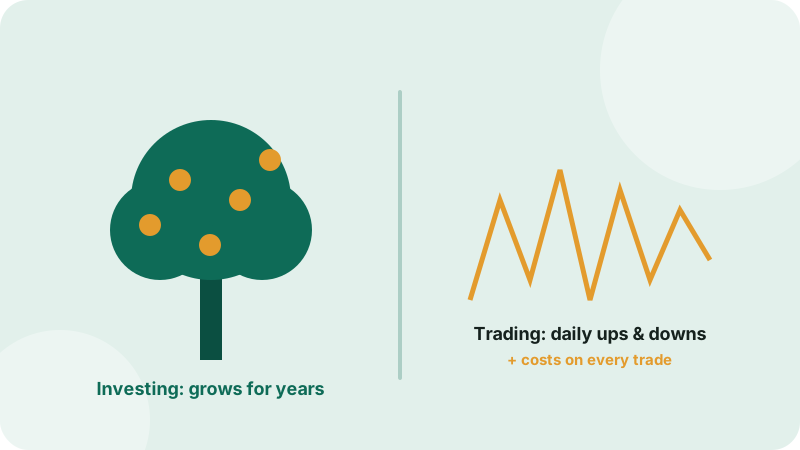
Two people can buy the same share for completely different reasons. One plans to own it for five years because the company is growing. The other plans to sell it tomorrow if the price goes up by 3%. The first is investing; the second is trading.
A farming example
An investor is like a farmer who plants a mango orchard. It takes years, but the trees keep producing fruit season after season.
A trader is like someone buying and reselling mangoes in the mandi every day. Possible profits each day, but also daily risk, constant attention, and transport costs on every deal.
Key differences
| Investing | Trading | |
|---|---|---|
| Holding period | Years | Minutes to weeks |
| Focus | Business quality, profits, dividends | Price charts and short-term moves |
| Time needed | A few hours a month | Watching the market daily |
| Costs | Low (few transactions) | High (many transactions) |
| Stress | Lower | Higher |
How trading costs add up
Every buy and sell has costs: broker commission, plus fees and taxes. Even if they seem small per trade, they add up quickly.
Suppose your total costs are about Rs 300 for each buy-and-sell round trip on Rs 100,000.
- Investor making 4 round trips a year: 4 × 300 = Rs 1,200 (1.2% of capital).
- Trader making 100 round trips a year: 100 × 300 = Rs 30,000 (30% of capital).
The trader must earn 30% just to break even before making any profit. Costs differ by broker, but the lesson holds.
Why investing works for most people
- You benefit from business growth: if a company's profits grow over the years, its share price tends to follow, although not in a straight line.
- Dividends: long-term holders collect dividends year after year.
- Compounding: reinvesting dividends and gains lets your money grow on itself.
- Less time and stress: you don't have to watch prices all day alongside your job or studies.
- Fewer emotional mistakes: short-term prices swing on news and rumours; long-term investors can ignore much of the noise.
Compounding example
Rs 100,000 growing at 12% a year (including reinvested dividends) becomes about:
- After 5 years: Rs 176,000
- After 10 years: Rs 311,000
- After 15 years: Rs 547,000
The longer you stay invested, the more compounding works for you. Returns are never guaranteed, and real markets go up and down along the way.
Is trading always wrong?
No. Some experienced people trade successfully with strict rules and risk control. But trading is a skill that takes time, capital and discipline, and losses are common while learning. If you're a beginner, start by investing, learn how companies and markets work, and only consider trading with a small amount you can afford to lose.