When you buy a company's shares, you become a part-owner of that business. Just as a shop owner checks the daily sales register, an investor should check how the company is doing. The best way is to follow its financial results.
Results are a report card
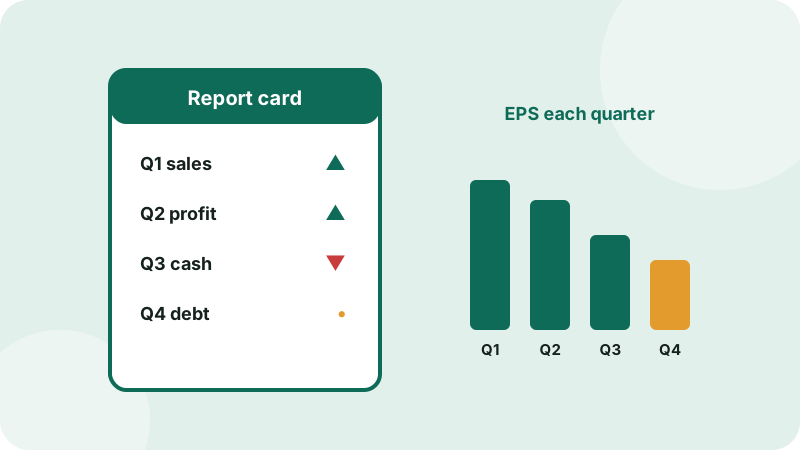
Parents check a child's report card every term, not just at the end of the year. If marks start slipping in one term, they find out early and can act. A company's quarterly results work the same way: they show whether the business is improving or slipping, long before problems become obvious to everyone.
When results come out
Companies listed on the PSX publish results every quarter: three quarterly or half-yearly reports plus an audited annual report. The company first announces a board meeting date, then publishes results and any dividend on the PSX Data Portal.
Example: spotting a warning early
| Quarter | Sales (Rs m) | EPS (Rs) |
|---|---|---|
| Q1 | 2,000 | 3.00 |
| Q2 | 1,900 | 2.60 |
| Q3 | 1,750 | 1.90 |
Sales have fallen for two quarters in a row, and EPS has dropped by more than a third (from Rs 3.00 to Rs 1.90). An investor who reads the results would ask why: higher costs? Lower demand? More debt? An investor who doesn't check might only find out when the share price has already fallen sharply.
Why it matters
- Spot problems early: falling sales, shrinking margins, rising debt or weak cash flow.
- Confirm good news: rumours of "record profits" can be checked against the real numbers.
- Understand dividends: dividends and bonus shares are usually announced with results.
- Know if the price still makes sense: if profits fall but the share price stays high, the P/E ratio rises and the share becomes expensive.
- Make calm decisions: knowing the facts helps you stay invested in good companies during market panics.
Your 10-minute quarterly check
- Sales: growing or falling compared with the same quarter last year?
- Profit and EPS: moving in the same direction as sales?
- Margins: is the company keeping more or less of each rupee of sales?
- Finance cost: is interest eating more of the profit?
- Cash flow: is operating cash flow positive?
- Debt: are borrowings rising quickly?
- Dividend: was one announced, and is it affordable from profits?
- Directors' comments: what challenges or plans does management mention?
Compare each quarter with the same quarter last year, because many businesses are seasonal (for example, fertiliser and cement demand change with the seasons).
One quarter isn't a trend
A single weak quarter can happen for temporary reasons. Look for patterns over several quarters, and read the explanation in the directors' report. For a fuller walkthrough, see how to read a financial report.