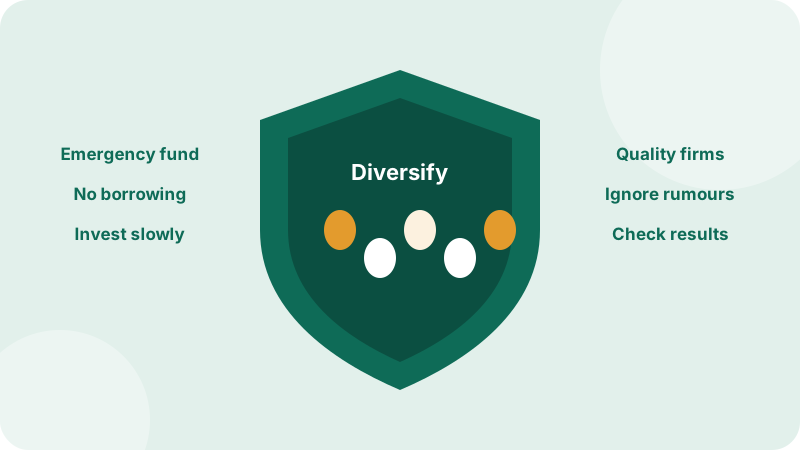
Every investment carries some risk. Share prices go up and down, and companies sometimes run into trouble. But many of the big losses new investors suffer are avoidable. These nine habits can greatly reduce your risk.
1. Don't put all your eggs in one basket
Zara has Rs 100,000. Compare two choices:
- Option A: all Rs 100,000 in one company. If it falls 50%, she loses Rs 50,000.
- Option B: Rs 20,000 in each of 5 companies from different sectors. If one falls 50% and the others stay flat, she loses Rs 10,000, just 10% of her money.
Spreading money across different companies and sectors (banks, energy, cement, technology, food) is called diversification. It means one bad event can't ruin your whole portfolio.
2. Keep an emergency fund first
Before investing, keep 3–6 months of household expenses in a bank account or savings. Otherwise, a sudden expense could force you to sell shares at a bad time, perhaps right after a market fall.
3. Invest only money you won't need soon
Shares can stay down for months or even a few years. Money for next year's wedding, fees or house payment shouldn't be in the stock market. A good rule: invest only money you won't need for at least 3–5 years.
4. Never invest borrowed money
Borrowing to buy shares (from family, a credit card or margin financing) multiplies losses. If the market falls, you still owe the full loan plus interest. Many investors have lost everything this way.
5. Invest gradually, not all at once
Instead of investing a large amount on one day, invest in parts over several months. You'll buy at a mix of prices and avoid the risk of putting everything in at a market peak. See our guide: why you shouldn't invest all your money at once.
6. Choose quality companies
Prefer companies with steady profits, manageable debt, positive operating cash flow and a good dividend record. Large, established blue chips are often a sensible starting point.
7. Ignore tips and rumours
"This share will double next week!" messages in WhatsApp groups are a common way small investors lose money, and sometimes they are deliberate attempts to push up a share's price before insiders sell. Check official information on the PSX Data Portal and make your own decisions.
8. Review your companies regularly
Read quarterly results and announcements for the companies you own. If a company's profits keep falling, debt is rising or the auditor raises concerns, it may be time to reconsider. See why tracking financial results matters.
9. Control your emotions
- Don't panic-sell when the market falls if the company is still healthy.
- Don't chase shares just because their price has already risen a lot.
- Write down why you bought each share, and sell only if those reasons change.
Consider mutual funds if you're starting out
If picking individual shares feels overwhelming, equity mutual funds managed by licensed asset management companies give you instant diversification across many companies, for a management fee.