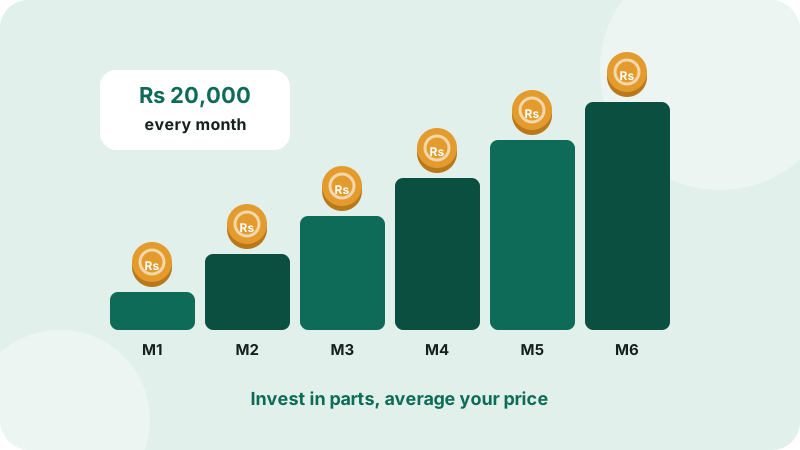
Imagine you've saved Rs 120,000 and want to start investing. Should you put it all into shares today? Most experienced investors would advise against it. Here's why investing in parts is usually the smarter, calmer approach.
Nobody knows the best day to buy
Share prices move up and down every day based on news, interest rates, politics and investor mood. Even professionals can't predict tomorrow's prices. If you invest everything on one day, and the market falls 20% next month, your whole investment drops with it, and many people panic and sell at a loss.
The solution: rupee cost averaging
Instead of investing a lump sum, you invest a fixed amount at regular intervals, for example every month. This is called rupee cost averaging (also known as cost averaging or a systematic investment plan).
It works like a monthly committee (BC): a fixed amount goes in every month, without worrying about whether this month is the "perfect" month.
Worked example: Rs 120,000 over 6 months
Saad invests Rs 20,000 every month in the same share instead of Rs 120,000 at once. The price moves like this:
| Month | Share price | Amount invested | Shares bought |
|---|---|---|---|
| 1 | Rs 100 | Rs 20,000 | 200.0 |
| 2 | Rs 80 | Rs 20,000 | 250.0 |
| 3 | Rs 70 | Rs 20,000 | 285.7 |
| 4 | Rs 90 | Rs 20,000 | 222.2 |
| 5 | Rs 100 | Rs 20,000 | 200.0 |
| 6 | Rs 110 | Rs 20,000 | 181.8 |
| Total | Rs 120,000 | 1,339.7 |
- Saad's average cost: 120,000 ÷ 1,339.7 = about Rs 89.6 per share.
- Lump sum in month 1 at Rs 100 would have bought 1,200 shares.
- At the month-6 price of Rs 110, Saad's shares are worth about Rs 147,400, versus Rs 132,000 for the lump sum.
Because Saad kept buying when the price fell, he bought more shares at low prices and lowered his average cost.
The emotional benefit
- When prices fall, you don't panic; you see it as a chance to buy more cheaply next month.
- You avoid the regret of "I invested everything at the top".
- You build a habit of investing from your salary every month.
Is a lump sum ever better?
To be fair: if prices rise steadily from day one, investing everything at once would have done better, because all your money was invested earlier. Markets have tended to rise over long periods, so some investors prefer to invest lump sums. But for most people, especially beginners, gradual investing reduces the risk of a badly timed start and makes it easier to stay invested through ups and downs.
How to do it
- Decide a monthly amount you can comfortably afford, after expenses and an emergency fund.
- Pick a fixed date each month, for example two days after salary day.
- Invest in a diversified set of quality companies or a mutual fund.
- Keep going during market falls. That's when averaging helps most.
- Review your holdings every few months, not every day.