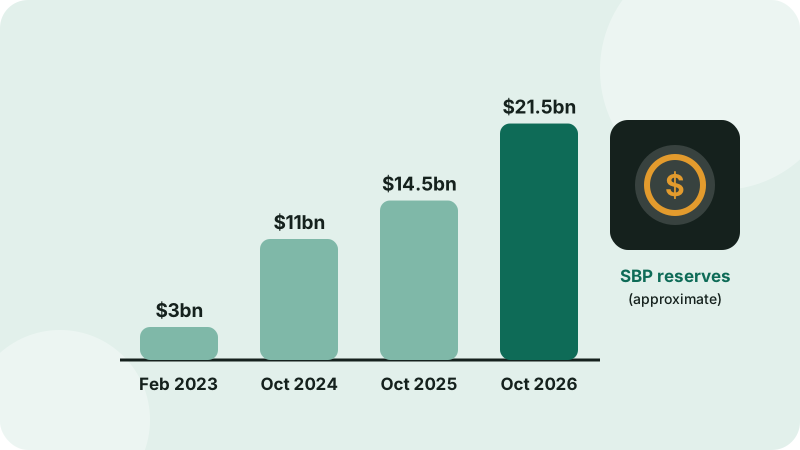
In February 2023, Pakistan's central bank held less than $3 billion in foreign exchange reserves, barely enough for a few weeks of imports. Containers were stuck at ports, the rupee was sliding and there was open talk of default. Today the State Bank of Pakistan (SBP) holds about $21.5 billion. That turnaround is one of the most important economic stories of the past few years, and it affects everything from the price of your phone to whether foreign investors buy Pakistani shares.
What are foreign exchange reserves?
Reserves are a country's savings in foreign currency, mostly US dollars, kept by the central bank. Pakistan needs dollars to pay for imports such as oil, machinery, cooking oil and medicine, and to repay foreign loans. Exports, remittances from overseas Pakistanis, foreign investment and loans bring dollars in. If more goes out than comes in for too long, reserves run down.
Think of a household that earns in rupees but must pay some bills in dollars. A healthy dollar savings account means it can pay those bills even in a bad month. A near-empty one means panic every time a bill arrives.
Where reserves stand now
| Measure (week to 23 Oct 2026) | Amount |
|---|---|
| Reserves held by the SBP | $21.52 billion |
| Net reserves held by commercial banks | $5.23 billion |
| Total liquid reserves | $26.75 billion |
| SBP reserves a year earlier (24 Oct 2025) | $14.47 billion |
That is an increase of roughly $7 billion, or almost 50%, in a single year. The SBP's own figure is the one that matters most, because it is what the central bank can use to defend the rupee and pay debts.
How the SBP did it
The main tool was surprisingly simple: buying dollars in the local market. When exporters and families receiving remittances convert dollars into rupees at their banks, the banks end up with spare dollars. The SBP buys some of them and pays in rupees.
- In the 12 months from August 2025 to July 2026, the SBP bought $8.78 billion this way, including $863 million in July alone.
- According to the SBP governor, the central bank has bought about $30 billion over four years. Around $12 billion of that went on interest payments on foreign debt, and the rest built up the reserves.
- Record remittances helped a great deal. The SBP now expects workers' remittances of about $45 billion this fiscal year, up from its earlier estimate of $44 billion.
- The current account (trade, services and remittances combined) was roughly balanced in FY26, so the country was not burning dollars faster than it earned them.
The debt mix has also improved. The SBP says about 80% of Pakistan's external debt is now owed to multilateral lenders (like the IMF and World Bank) and friendly governments, compared with about 55% in 2023. These loans are usually cheaper and easier to roll over than commercial borrowing.
Why it matters to ordinary people
- A steadier rupee. The interbank rate has stayed around Rs276-277 per dollar through October. A stable rupee keeps imported goods, fuel and medicine from suddenly jumping in price.
- No import queues. With about three months of import cover, banks can open letters of credit for importers without restrictions, so shelves stay stocked and factories get raw materials.
- Confidence for investors. Foreign and local investors watch reserves closely. Healthy reserves reduce the fear of a sudden devaluation, which makes Pakistani shares and bonds more attractive.
- Room to absorb shocks. A buffer means an oil price spike or a bad harvest does not instantly turn into a currency crisis.
The targets
The SBP aims for $23 billion by December 2026 and $25 billion by June 2027. At $25 billion, it estimates import cover would rise to about four months. The SBP says these targets already account for upcoming debt repayments and the expected current account deficit.
The risks that remain
- Oil prices. This is the big one. Research by PIDE estimates that every $10 rise in the oil price adds about $1.8-2 billion a year to Pakistan's import bill. The prime minister has said the weekly oil import bill rose from about $300 million before the war to around $800 million. Brent crude was trading above $116 a barrel in late October.
- A widening current account deficit. It was $874 million in the first quarter of FY27. The SBP expects the full-year deficit to stay within 0-1% of GDP, but higher oil and stronger imports could push it up.
- Is the rupee too strong? Some analysts point out that the SBP's real effective exchange rate index is at its highest level since 2018, which suggests the rupee may be overvalued. An overvalued currency makes imports cheap and exports less competitive. The SBP's answer is that it is buying dollars steadily and letting the market set the rate.
- Debt repayments. Reserves rise and fall with large loan repayments and new loans. One week's number can move by hundreds of millions of dollars for reasons that have nothing to do with the economy's health.
How to follow it yourself
The SBP publishes reserve figures every Thursday afternoon on its website. Look at the trend over several weeks, not a single week. A steady climb is a good sign for the rupee, inflation and the stock market. A fast fall usually means trouble is coming and is worth paying attention to.
The bottom line
Pakistan has gone from the edge of default to its strongest reserve position in years, largely by buying dollars patiently and keeping the current account in check. That gives the economy breathing space. But reserves of three months' imports are a cushion, not a fortress, and oil prices will decide how comfortable that cushion stays. For context on how this links to interest rates and prices, see our explainers on the rate hike to 12% and October's inflation.