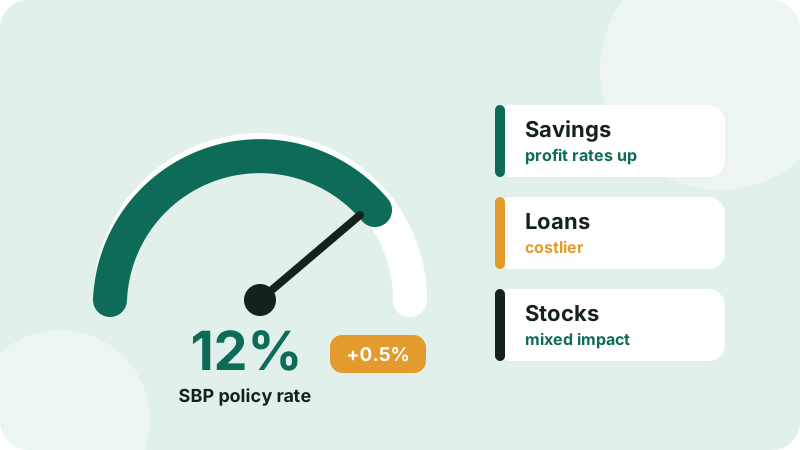
On 26 October 2026, the State Bank of Pakistan (SBP) announced that it would raise its main interest rate, the policy rate, from 11.5% to 12%, with effect from the next day. Nine of the ten members of its Monetary Policy Committee voted for the increase. It was the second hike this year, after a one percentage point rise in April, and it ended a run of three meetings in which the rate was left unchanged.
A half-point move sounds small. But the policy rate is the anchor for almost every rupee interest rate in the country, so it quietly touches your savings account, your car or home loan, the National Savings certificates your parents hold, and the share prices on the PSX. This guide walks through each one.
First, what is the policy rate?
Think of the policy rate as the "price of money" set by the central bank. Banks borrow from and lend to each other, and to the SBP, at rates that stay close to it. The SBP keeps them inside a band called the interest rate corridor. After this decision the band runs from 11% (floor) to 13% (ceiling), with the policy rate in the middle.
When the price of money goes up, banks pay more on deposits and charge more on loans. People borrow and spend a little less, and over time that helps slow down price rises. That is the whole logic of a rate hike.
Why did the SBP raise rates now?
Three things worried the central bank:
- Inflation is too high. Prices were rising about 10% a year in September, roughly double the SBP's medium-term target of 5-7%. It has been above that target since the spring.
- Energy and food are expensive. The war involving the US, Israel and Iran pushed global oil above $100 a barrel for long stretches this year. Brent crude was around $116 a barrel just days before the meeting. Pakistan imports most of its oil, so this feeds straight into petrol, diesel, electricity and transport costs. Wheat prices at home have also been high.
- The "real" interest rate had become thin. If inflation is 10% and the policy rate is 11.5%, savers earn only about 1.5% in real terms. Analysts estimated that the hike lifts this cushion to around 2.5%, which makes holding rupees more attractive and discourages people from rushing into dollars, gold or property.
The SBP kept its growth forecast for this fiscal year (FY27) at 3.5-4.5% and expects the current account deficit to stay between 0 and 1% of GDP. In other words, it does not think the economy is in trouble; it wants to stop inflation from settling at a high level.
What it means for your savings
This is the good news part. When the policy rate rises, banks usually raise the profit they pay on savings accounts and term deposits, though each bank moves at its own pace.
There is also a rule many savers do not know about. The SBP requires conventional banks to pay a minimum profit rate on rupee savings deposits, set 0.5 percentage points below the corridor floor. Since 1 August 2026 the rule protects individuals whose monthly average balance is up to Rs10 million. With the floor now at 11%, that works out to a minimum of about 10.5% a year, up from about 10%. (Islamic banks follow a separate profit-sharing system, and you should always check your own bank's rate sheet.)
Example: Ayesha keeps Rs1,000,000 in a savings account. If her rate rises from 10% to 10.5%, her yearly profit before tax goes from Rs100,000 to Rs105,000, an extra Rs5,000 a year. Withholding tax is deducted from this, and it is much higher for non-filers, so being on the active taxpayer list matters.
National Savings rates usually follow too. As of 21 October, before the hike, the National Savings Account paid 10%, Special Savings Certificates 12%, and Behbood certificates and the Pensioners' Benefit Account 12.96%. Watch for the next revision.
What it means for borrowers
Most car loans, home loans and business loans in Pakistan are priced as KIBOR plus a margin. KIBOR moves with the policy rate, so your instalment changes at the next reset date written in your loan agreement (often every 6 or 12 months).
Example: Bilal has a 5-year car loan of Rs2,000,000. If his rate moves from 15% to 15.5%, his monthly instalment rises from about Rs47,580 to about Rs48,106, roughly Rs525 more each month, or about Rs6,300 a year.
You can test your own numbers with our loan calculator. If you have a fixed-rate loan, nothing changes for you.
What it means for the stock market
A rate hike is often called "bad for stocks", but the real picture is mixed:
- Banks can benefit. They earn more on the loans and government bonds they hold. The day after this decision, all 14 banks in the KSE-100 rose and the index gained about 1,400 points.
- Heavily indebted companies suffer. Higher interest costs eat into profits, which can lower their earnings per share.
- Competition from safe returns. When a bank deposit pays 10-12% with no risk, some investors move money out of shares. That can weigh on prices, especially of companies with low dividend yields.
The market's calm reaction suggests investors had expected a small hike, and some read it as the SBP acting early so it does not have to do something bigger later.
What happens next?
The next big clue was the October inflation figure. It came in at 9.6%, a little lower than September (read our inflation explainer). The Monetary Policy Committee meets again on 14 December 2026. If oil prices calm down and inflation keeps easing, the SBP may hold rates steady. If oil spikes again, another increase is possible.
The bottom line
- If you are a saver, this is a good time to compare bank and National Savings rates and make sure your money is not sitting in a current account earning nothing.
- If you are a borrower, check your loan's reset date and budget for a slightly higher instalment.
- If you are an investor, remember that rate changes affect sectors differently. Spreading your money, as explained in our guide on reducing investment risk, protects you from any one policy surprise.