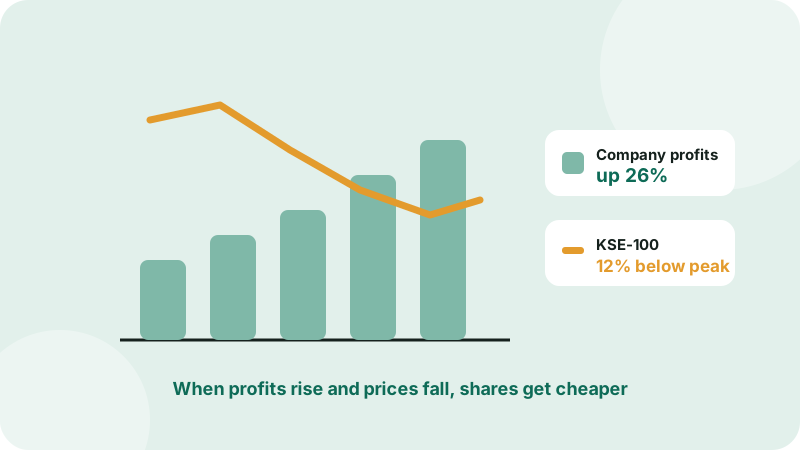
Here is a puzzle that confuses many new investors. In the first nine months of 2026, the companies in Pakistan's KSE-100 index earned about 26% more profit than in the same period of 2025, according to brokerage research. Yet on 2 November the index closed at 166,564, roughly 12% below the record close of 189,167 it hit in January. If businesses are making more money, why are their shares worth less?
The answer teaches one of the most useful lessons in investing: share prices are driven by profits and by how much investors are willing to pay for those profits. Those two things can move in opposite directions for months.
A quick look at the year so far
| Date | KSE-100 close | What was happening |
|---|---|---|
| 23 January 2026 | 189,167 | Record close, on hopes of rate cuts and foreign inflows |
| 30 June 2026 (end of FY26) | 180,302 | Index still up about 44% for the fiscal year |
| 30 September 2026 | 169,969 | September fell nearly 4% |
| 30 October 2026 | 166,409 | October fell 2.1% (3,560 points) |
| 2 November 2026 | 166,564 | About 12% below the January peak |
Why prices fell while profits rose
1. War and oil changed the mood
The war involving the US, Israel and Iran began in late February and sent oil prices soaring. For an oil-importing country like Pakistan, that means higher inflation, pressure on the rupee and a bigger import bill. Investors do not wait for these problems to show up in company accounts; they price in the risk immediately. Every rumour about peace talks or tanker attacks in the Strait of Hormuz has moved the market this autumn.
2. Interest rates went up instead of down
In January, the market was rising partly because investors expected the State Bank to cut rates. Instead, the SBP raised the policy rate from 10.5% to 11.5% in April and to 12% in October. When safe bank deposits and government bonds pay 10-12%, shares have to offer more to attract money. Investors respond by paying less for each rupee of profit. (Our rate hike explainer covers this in detail.)
3. Foreigners have been selling
Foreign investors sold about $848 million of Pakistani shares in FY26, and brokerages cited foreign outflows again as a reason for October's decline. When a big group of investors keeps selling, prices drift lower even if the companies are doing well.
4. Profit-taking after a huge run
The KSE-100 had gained about 44% in FY26 and had risen several-fold since 2023. After such a run, many investors simply locked in gains. That is normal market behaviour and does not mean anything is wrong with the companies.
Is the 26% profit growth as good as it looks?
Not entirely, and this is worth understanding. A large part of the jump came from a one-off tax reversal after a court ruling on the super tax, which boosted company profits in the April-June quarter. One-off gains do not repeat every year, so smart investors strip them out when judging a company's real earning power.
Sector results have also been uneven. For example, listed fertiliser companies grew profits about 9% in the nine months, and Fauji Fertilizer reported a 12.7% rise in profit to Rs71 billion, with earnings per share of Rs48.77. Solid, but not 26%. Banks, which carry the biggest weight in the index, have been growing profits in single digits for much of the year.
The lesson: always ask why profits rose. Read our guide on why tracking company results matters to learn how to spot one-off items.
What happens to valuations: the P/E ratio
The price-to-earnings (P/E) ratio tells you how many rupees investors pay for one rupee of yearly profit. When profits go up and prices go down, the P/E falls.
Example: Sitara Foods Ltd (a fictional company) earned Rs10 per share last year and its share traded at Rs100, a P/E of 10. This year it earns Rs12 per share, but the share price has slipped to Rs96.
New P/E = Rs96 ÷ Rs12 = 8. Investors now pay Rs8 for each rupee of profit instead of Rs10. The share is "cheaper" relative to what the business earns, even though its price only fell 4%.
This is what has been happening across much of the market in 2026. A lower P/E can be an opportunity, but it is not a guarantee. Sometimes a P/E is low because investors expect profits to fall next year, or because risks (like war or a currency shock) have genuinely increased. Combining P/E with growth, as in the PEG ratio, gives a fuller picture.
What brokerages are saying
Analysts at Topline and Arif Habib blamed October's fall on geopolitical uncertainty, foreign outflows, profit-taking in heavyweight stocks and cautious sentiment. At the same time, they pointed to strong earnings as a reason the market recovered in late October, when it ended a five-week losing streak with a 2.5% weekly gain. Earlier in the year, some brokerages had forecast the index would reach 203,000 or more by December 2026; with two months left, the market is far from those targets, a reminder that forecasts are educated guesses, not promises.
What this means for you
- Do not judge a company only by its share price. A falling price with rising profits is a very different story from a falling price with falling profits.
- Check for one-off gains. Look at "other income" and tax lines in the results, not just the headline profit.
- Be patient and gradual. Nobody knows when sentiment will turn. Buying in steps, as explained in why not to invest all your money at once, removes the pressure of picking the perfect day.
- Keep risk in check. Spread your money across sectors and never invest money you will need in the next few years.
The bottom line
In the long run, share prices tend to follow company profits. In the short run, fear, interest rates and money flows can pull them apart. 2026 has been a clear example: Pakistani companies are, on the whole, earning more, but investors are paying less for those earnings because the world feels riskier. Understanding that gap is the difference between panicking at a falling index and calmly asking whether the businesses you own are still growing.
This article is for education only and is not investment advice. Company names other than FFC in the examples are fictional.