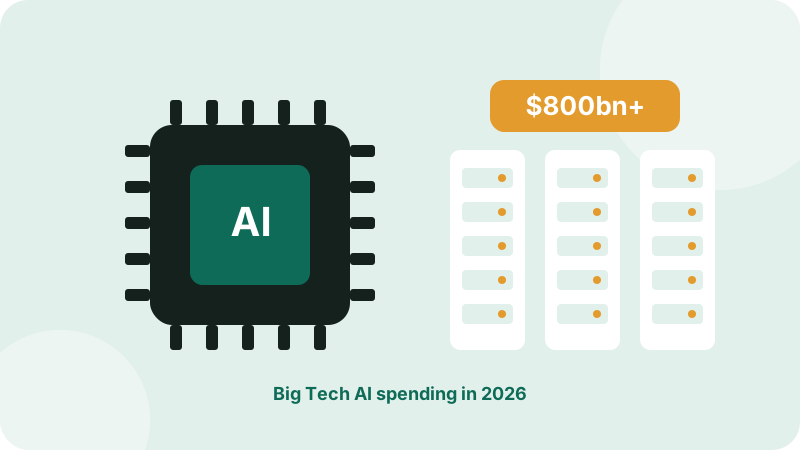
When the world's largest technology companies reported their results at the end of October 2026, one number grabbed attention: how much they are spending to build artificial intelligence. Amazon, Alphabet (Google), Microsoft and Meta are on track to invest roughly $800 billion or more in 2026, mostly on data centres, AI chips and the power to run them. All of them say they will spend even more in 2027.
That is roughly twice the size of Pakistan's entire economy. This explainer looks at what the money is buying, why it matters for the global economy, the "bubble" debate, and what it all means for Pakistan.
How big is the spending?
- Combined capital spending by the largest US tech firms reached about $227 billion in the July-September quarter alone, and around $556 billion in the first nine months of 2026.
- Full-year 2026 spending is projected at about $803-828 billion.
- Amazon spent about $76 billion in the third quarter, mostly for its cloud and AI business. Meta raised its 2026 range to $135-145 billion. Alphabet's finance chief said spending would "increase significantly" in 2027.
- Research firm Dell'Oro expects total global data-centre investment to exceed $1 trillion in 2026.
What the money is buying
- AI chips (mostly graphics processors) that train and run AI models.
- Data centres: huge buildings full of servers.
- Electricity: AI data centres use enormous amounts of power, and companies are signing long-term deals for new power plants.
- Networking and cooling to connect and run it all.
How it is reshaping the world economy
Stock markets
AI companies have driven much of Wall Street's gains. Chipmaker Nvidia, the biggest winner, had risen roughly 15-fold since the end of 2022 by mid-October 2026. The S&P 500 set more than two dozen record highs this year, largely on AI enthusiasm. But the swings are violent: in mid-October an AI sell-off sent South Korea's Kospi index down 7.6% and Japan's Nikkei down 4.9% in a single day.
Metals and energy
The World Bank says demand from data centres, electric vehicles and renewable energy is pushing industrial metals prices up about 25% in 2026 to record levels. Copper, aluminium and other metals are needed in huge quantities for servers, cables and power grids.
Interest rates
Massive corporate investment keeps demand for money high, one of the reasons global interest rates are staying elevated (see the end of cheap money).
Boom or bubble?
This is the big debate.
The optimists' case: AI is a genuine technology shift, like electricity or the internet, and the companies spending most also earn huge profits and have strong cloud growth. Demand for computing power still exceeds supply.
The sceptics' case: the spending is running ahead of proven profits. If AI revenue does not grow fast enough to justify the investment, today's data centres could become the most expensive under-used assets in corporate history, and share prices could fall sharply.
The IMF sits in the middle. In its October World Economic Outlook it lists the concentration of AI investment and the risk of an equity correction, if AI profitability disappoints, among the main threats to global growth. (See our IMF explainer.)
A lesson from history: in the late 1990s, companies spent heavily on internet cables and infrastructure. Many investors lost money when the dot-com bubble burst in 2000, yet the internet itself went on to change the world. AI may follow a similar path: the technology can be real even if some investments and share prices turn out to be overdone.
What it means for Pakistan
The opportunity
- IT exports are at a record. Pakistan's IT and computer services exports reached about $4.6 billion in FY26, up around 21%, and freelancers contribute a significant share. The government targets $10 billion by FY29. AI development, data labelling, software integration and AI-enabled services are growing markets for Pakistani firms and freelancers.
- Cheaper tools. AI tools let small Pakistani businesses and freelancers do work that once needed large teams, from design to coding to customer service.
The risks
- Pressure on routine digital work. Basic content writing, simple coding, data entry and some call-centre work are the tasks AI automates most easily. Freelancers who rely on them need to move up the value chain.
- Power and connectivity. Pakistan's frequent internet disruptions and high electricity costs make it hard to compete for AI data-centre investment.
- Market spillovers. A sharp fall in global tech stocks would hit global investor confidence and could reduce foreign appetite for emerging-market assets, including the PSX.
What you can do
- If you work in tech or freelancing, learn to use AI tools well and focus on skills AI cannot easily replace: understanding clients, solving business problems, and specialised knowledge.
- If you invest, remember that booms bring big gains and big swings. Do not chase the hottest theme with money you cannot afford to lose; read investing vs trading first.
- If you run a business, look for practical, low-cost ways AI can save time, such as drafting, customer replies and bookkeeping.
The bottom line
Big Tech's AI spending is one of the largest investment waves in economic history. It is lifting stock markets, metals demand and energy use, and it carries real risk if profits do not follow. For Pakistan, the AI era is both a door and a warning: a chance to grow tech exports and productivity, and a push to upgrade skills before routine digital work is automated away.
Company names in this article are real companies mentioned for news context only. This is not investment advice.