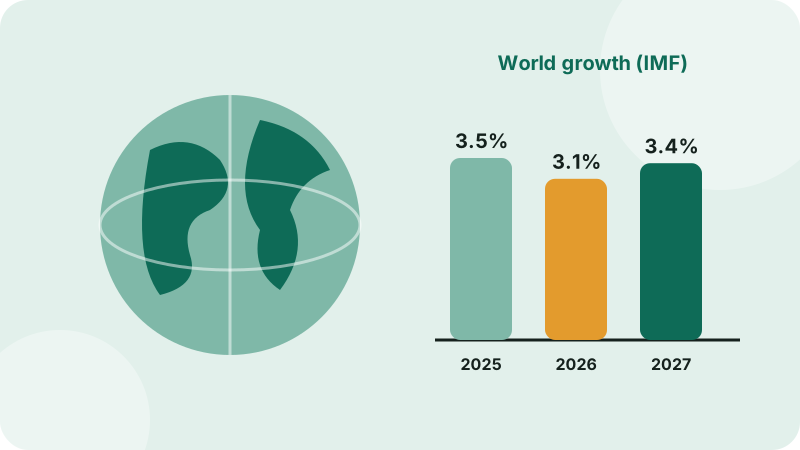
Twice a year, the International Monetary Fund (IMF) publishes its World Economic Outlook, the most closely read forecast of the global economy. Governments, central banks, investors and rating agencies all use it. The October 2026 edition was launched on 12-13 October at the IMF and World Bank Annual Meetings in Bangkok, under a title that sums up its message: "Resilience Under Strain, Urgent Choices."
In short, the IMF says the world economy has coped surprisingly well with a war, an oil shock and high interest rates, but its ability to absorb the next shock is wearing thin. This explainer walks through the key forecasts, why they matter, and where Pakistan fits in.
The headline numbers
| Economy | 2025 | 2026 (forecast) | 2027 (forecast) |
|---|---|---|---|
| World | 3.5% | 3.1% | 3.4% |
| Advanced economies | 2.0% | 2.1% | 1.8% |
| Emerging and developing economies | 4.5% | 3.7% | 4.4% |
| United States | 2.3% | 2.3% | 2.3% |
| China | 5.0% | 4.5% | 4.0% |
| India (fiscal year) | 7.8% | 7.0% | 7.0% |
Two things stand out. First, the slowdown in 2026 is concentrated in emerging and developing economies, the group Pakistan belongs to. Their growth drops from 4.5% to 3.7%, a much bigger fall than in rich countries. Second, the IMF expects a rebound in 2027, but only if the shocks of 2026 do not get worse.
Inflation: the problem that will not go away
The IMF projects global headline inflation at 4.7% in 2026, easing to 4.1% in 2027. The main drivers are food and energy. Core inflation, which strips those out, is expected to be lower at 3.9% and 3.7%, a sign that the problem comes mostly from supply shocks rather than from people spending too much.
This matters because it means central banks around the world, from the US Federal Reserve to the State Bank of Pakistan, cannot cut interest rates as quickly as many had hoped at the start of 2026. (We explain this in the end of cheap money.)
Why "resilience under strain"?
The IMF's research chief, Silvana Tenreyro, summed it up by saying the global economy has been resilient, "but that resilience is under strain." The report identifies three pressure points:
- Energy supply disruptions. The war in the Middle East has pushed up the prices of crude oil, gas, diesel and jet fuel. Oil stockpiles around the world have been run down, so there is less of a cushion if supplies are hit again. See our explainer on the world's shrinking oil cushion.
- A concentrated AI boom. A large share of global investment and stock-market gains is tied to artificial intelligence. If AI profits disappoint, the IMF warns, share prices could fall sharply and drag down spending. We cover this in Big Tech's $800 billion AI bet.
- Rising government debt. Many governments borrowed heavily in recent years and now face higher interest costs. That leaves less room to support their economies in the next crisis.
In a downside scenario where commodity prices stay about 40% higher and borrowing costs rise further, the IMF estimates world growth could be another half a percentage point lower by 2027.
What the IMF says about Pakistan
For Pakistan, the IMF's October numbers are cautious:
- Growth: about 3.5% in FY2026-27, below the government's 4% target and the SBP's 3.5-4.5% range.
- Inflation: close to 9.9%, meaning prices are expected to keep rising near double digits for another year.
- Current account: a deficit of about 1% of GDP, after a surplus earlier. In plain words, Pakistan is expected to spend more dollars on imports and payments than it earns, mainly because oil is expensive.
Put next to the global picture, Pakistan's growth is roughly in line with the world average but well below neighbouring India (7%), and far below what is needed to create jobs for its young and fast-growing population.
Why these forecasts matter to ordinary people
Jobs and incomes: 3.5% growth with about 2% population growth means average incomes rise only slowly. Many economists estimate Pakistan needs growth of 6% or more for many years to make a real dent in unemployment and poverty.
Prices: inflation near 10% means your rupee buys noticeably less each year. Savings need to earn at least that much after tax just to keep their value (see our inflation explainer).
The rupee and imports: a wider current account deficit puts pressure on the rupee and on reserves, which is why the SBP is keen to keep buying dollars and holding interest rates high.
How reliable are IMF forecasts?
Forecasts are educated estimates, not promises. The IMF revises them every few months as conditions change, and in 2026 it has already changed its numbers several times because of the war. A better way to use the WEO is to read the direction and the risks: right now, the direction is modest growth with stubborn inflation, and the risks lean to the downside.
What to take away
- The world is not in recession, but growth is slower and inflation higher than hoped, and that is likely to last through 2027.
- Energy prices, AI-driven markets and government debt are the three things to watch.
- For Pakistan, the forecast is "stable but slow": steady reserves, high-ish inflation and modest growth. Planning your savings for high inflation and high interest rates, rather than betting on quick relief, fits this outlook best.