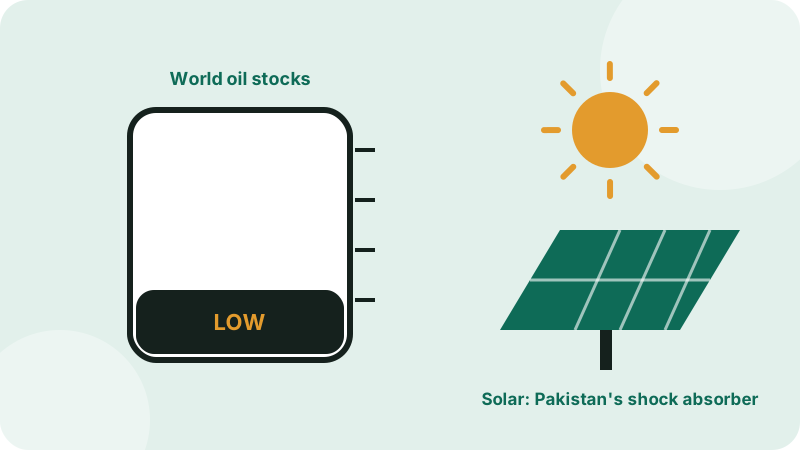
Oil prices make headlines every day as they jump and fall with news from the Middle East. This article is not about those daily swings. It is about something slower and more important: the world's oil safety cushion is getting thin, and that changes how exposed countries like Pakistan are to the next shock, whenever it comes.
What the World Bank found
In its October 2026 Commodity Markets Outlook, the World Bank projects that global oil supply will fall 5.2% in 2026. Outside the 2020 pandemic recession, that is the biggest drop in more than four decades. Oil consumption is also falling, by about 2.5%, because high prices force people and businesses to use less. But supply is falling faster than demand.
When production is lower than consumption, the gap has to be filled from stockpiles: oil stored in tanks, caverns and ships around the world. The World Bank warns that these stocks have been drawn down, leaving markets "more exposed to renewed disruption." It also notes that damage to Russian energy infrastructure cut Russia's fuel exports in the third quarter.
Think of it like a household water tank. If the supply line is cut for a day, a full tank keeps the taps running and nobody panics. If the tank is already half empty, the same cut causes a crisis. The world's oil tank is lower than usual, so the next supply problem is likely to cause a bigger price spike.
Why Pakistan is especially exposed
- Heavy import dependence: Pakistan imports roughly 80-85% of its petroleum needs.
- One narrow route: up to 90% of Pakistan's crude oil and LNG imports pass through the Strait of Hormuz, the narrow channel between Iran and the Arabian Peninsula that has been at the centre of the 2026 conflict.
- Thin reserves: Pakistan has no strategic petroleum reserve. Oil marketing companies must keep about 20 days of fuel, and refineries hold a few days of crude. Officials have described total cover of roughly three to four weeks. By comparison, India holds around 60-75 days and members of the International Energy Agency aim for 90 days.
- Every dollar counts: each $10 rise in the oil price adds an estimated $1.8-2 billion a year to Pakistan's import bill. During the worst of the crisis, the prime minister said the weekly oil import bill had jumped from about $300 million to $800 million.
What energy security means
Energy security is not about getting the cheapest oil. It is about making sure the lights stay on, trucks keep moving and prices do not explode when something goes wrong far away. It rests on four pillars:
- Storage: enough reserves to ride out a disruption.
- Diversity of supply: buying from several countries and routes.
- Local sources: producing more energy at home.
- Efficiency: using less energy for the same output.
What Pakistan is doing
1. Building a strategic reserve
After the 2026 shock, the government began work on a Strategic Petroleum Reserve. The Petroleum Division's framework envisages reserves equal to 60 days of crude oil and 30 days of petroleum products, and Pakistan has invited friendly oil-producing countries to store oil in Pakistan under joint arrangements. Feasibility work has started, though earlier plans in 2006 and 2023 did not materialise, so delivery is the real test.
2. The solar revolution
Pakistan's biggest energy shock absorber turned out to be something few planned for: rooftop solar. Driven by cheap Chinese panels and high electricity bills, Pakistan has imported more than 50 gigawatts of solar panels in the past few years, and think tank Renewables First estimated about 51 GW deployed by March 2026. One study estimated this saved around $12 billion in LNG imports between 2021 and early 2026. Battery imports are also rising fast, letting homes and businesses store daytime solar power.
3. Rethinking demand
Daily fuel pricing, targeted subsidies for motorcycles and rickshaws, and energy conservation measures are all attempts to manage demand without breaking the budget.
What it means for you
- Expect fuel prices to stay volatile. With thin global stocks, any disruption can move prices quickly. Budget for swings, not just the average.
- Solar still makes sense for many households. Net-metering rules have changed to a less generous "net billing" system, but solar plus a battery can still cut bills and protect you from tariff shocks. Calculate payback carefully before investing.
- For investors: energy policy decisions, such as refinery margins, levies and circular debt, can hit specific PSX sectors hard. Spreading your investments helps (see reducing investment risk).
The bottom line
The 2026 oil shock exposed how little room for error Pakistan has. The world's oil cushion is thin, and Pakistan's own cushion is thinner still. The long-term answers are clear: build real reserves, keep diversifying towards solar and local energy, and use energy more efficiently. How fast those happen will decide how painful the next oil crisis is. For the wider price outlook, see our explainer on the World Bank's commodity forecasts.