Every April and October, the World Bank publishes its Commodity Markets Outlook, a forecast for the prices of the raw materials the world runs on: oil, gas, coal, wheat, rice, cooking oil, fertiliser, cotton, metals and gold. The October 2026 edition, released on 28 October, carries a clear warning: prices have jumped this year and will stay high well into 2027.
For a country like Pakistan, which imports much of its fuel, cooking oil and fertiliser inputs, these global prices end up in the price of almost everything we buy. Here is what the report says and what it means for you.
The big picture: a 23% jump
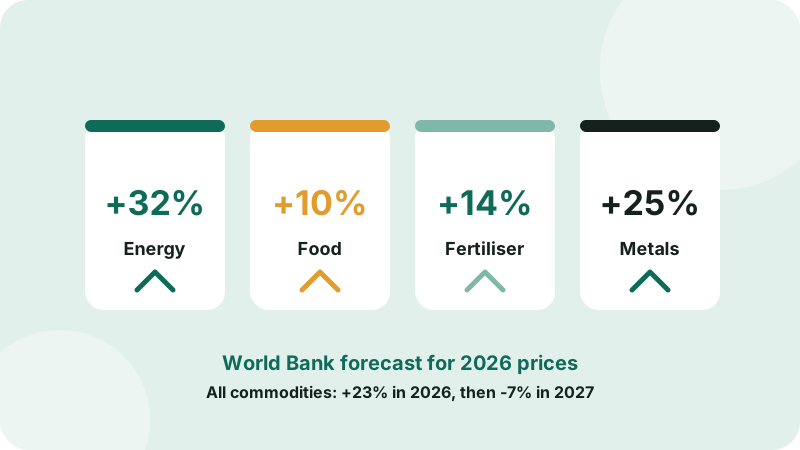
The World Bank expects its overall commodity price index to rise 23% in 2026, up from the 16% it had forecast in April. That would take prices to their second-highest level since 2013. In 2027, prices are forecast to fall by only 7%, which still leaves them far above where they were before the latest shocks.
The World Bank's deputy chief economist, Ayhan Kose, described commodity markets as being hit by "several major shocks at once." The main ones are:
- The war in the Middle East, which has disrupted oil and gas supplies and shipping routes.
- Problems with grain shipments through the Black Sea.
- Weather risks, especially El Niño, which can damage harvests.
- Strong demand for metals from data centres, electric vehicles and renewable energy.
Forecasts by commodity
| Commodity group | 2026 change | What drives it |
|---|---|---|
| Energy | +32% | War-related supply losses; first rise after three years of declines |
| Brent crude (average) | $91/barrel | Up from $69 in 2025; forecast $79 in 2027 |
| Food | about +10% | Shipping problems and weather; another +7% expected in 2027 |
| Fertiliser | +14% | Urea spiked early in the year; expected back to 2025 levels in 2027 |
| Industrial metals | +25% | Data centres, electric vehicles and clean energy |
| Precious metals | +40% | Safe-haven demand for gold and silver |
These forecasts assume the conflicts affecting supply do not get significantly worse. In a bad scenario with severe weather and more shipping disruption, the World Bank says food prices could end up about 12% higher than its main forecast.
What it means for Pakistan
1. Your kitchen bill
Pakistan imports large amounts of palm and soybean oil, pulses and tea, and food makes up a big share of what households spend. When world food prices rise 10% one year and 7% the next, a cumulative rise of about 18%, local prices of cooking oil, ghee and imported pulses tend to follow, especially if the rupee weakens at the same time.
Example: a family that spends Rs20,000 a month on imported or import-linked food items could see that bill drift towards Rs23,500 over two years if global prices pass through fully, before counting any rupee movement or local factors.
2. Fuel and electricity
An average Brent price of $91 this year, against $69 last year, means Pakistan pays much more for every barrel it imports. Research by PIDE estimates that each $10 rise in the oil price adds roughly $1.8-2 billion a year to Pakistan's import bill. Higher fuel costs also feed into electricity tariffs through fuel cost adjustments.
3. Farmers and fertiliser
A 14% rise in fertiliser prices squeezes farmers' margins and can lead them to use less fertiliser, which lowers yields. The good news is that the World Bank expects fertiliser prices to return to 2025 levels in 2027.
4. Cotton and the textile industry
The report projects Pakistan's cotton production to fall about 6% in 2026-27, while world cotton prices are forecast to rise about 14% this year. That is a double blow for the textile sector, Pakistan's biggest exporter: less local cotton and more expensive imported cotton.
5. Gold
The 40% rise in precious metals explains why gold has become so expensive in rupees per tola this year, even though global prices have fallen back from their January peak.
Is there any good news?
- Prices are expected to ease in 2027. Oil is forecast to average $79 and fertiliser to fall back.
- Some Pakistani exporters benefit. Rice exporters and companies that sell commodities abroad can earn more when world prices are high.
- Solar is a buffer. Pakistan's rapid adoption of rooftop solar has reduced how much imported fuel the country needs for electricity, softening the energy shock.
What you can do
- Plan for food and fuel to stay expensive through 2027. Build that into your household budget rather than waiting for relief.
- Protect your savings from inflation. Compare bank and National Savings rates and avoid keeping large sums idle.
- If you invest, understand which companies gain and which lose from high commodity prices. Exporters and commodity producers may benefit, while companies that import raw materials may see margins squeezed. Our guide to tracking company results helps you spot the difference.
The bottom line
The World Bank's message is that the commodity shock of 2026 will not simply vanish next year. Prices should cool a little in 2027, but they will remain high by historical standards. For Pakistan, that points to continued pressure on food, fuel and the trade balance, and to the importance of keeping reserves, inflation control and energy diversification on track. For the full global picture, see our explainer on the IMF's World Economic Outlook.