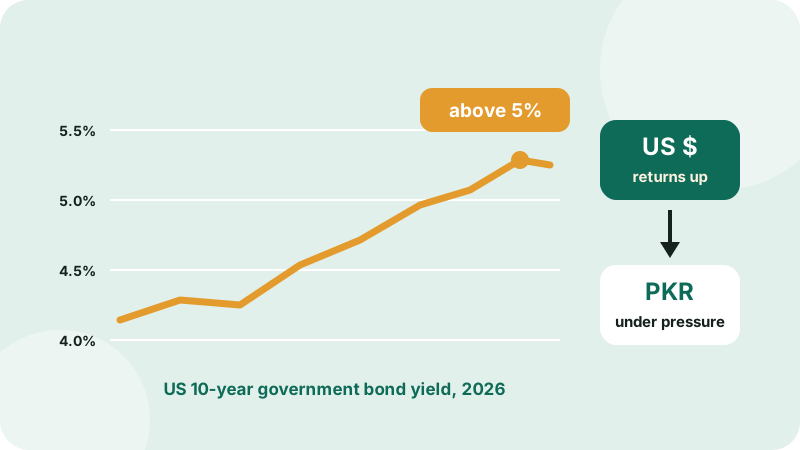
For most of the past two decades, the world got used to cheap money. Interest rates in the United States and Europe were close to zero for years, and investors went hunting for better returns in places like Pakistan, India and Turkey. That era is over. In 2026, rates in the world's most important economy are going up again, and the market for US government debt is sending its strongest warning signal in almost 20 years.
This explainer covers what is happening, why, and how it travels all the way to the rupee, the KSE-100 and your bank deposit.
What the US Federal Reserve has done
The Federal Reserve (the "Fed") is America's central bank. Because the US dollar is the world's main currency, its decisions affect borrowers and investors everywhere.
- In September 2026, the Fed raised its benchmark rate by 0.25 percentage points to a range of 3.75-4.00%, its first hike since 2023.
- On 28 October, it held rates steady. But the vote was 10 to 2, and both dissenters wanted another hike. Many analysts called it a "hawkish hold": no change today, but a clear lean towards higher rates.
- The Fed's own projections from September show the median official expecting rates of about 4.1% at the end of 2026 and still at that level in 2027. Futures markets priced a high chance of another hike at the 9 December meeting.
The reason is the same one the State Bank of Pakistan gives: inflation. The oil shock from the Middle East war, strong US economic growth and heavy government borrowing have kept American prices rising faster than the Fed's 2% target.
The 5% warning sign
Even more important than the Fed's short-term rate is the 10-year US Treasury yield, the interest rate the US government pays to borrow for ten years. It is the anchor for mortgages, corporate loans and the value of assets all over the world.
This yield started 2026 at around 4.15%. On 14 September it crossed 5% for the first time since a brief spike in October 2023, and later in September it rose to its highest level since 2007. In early October it reached roughly 5.3%.
Why should a Pakistani care about a US bond? Imagine you are a large global investor. If the US government, the world's safest borrower, now pays you over 5% a year in dollars with almost no risk, you need a much higher return to take the extra risk of investing in a Pakistani share or bond. When "safe" pays more, money flows out of riskier places.
Why rates are rising: three forces
- Sticky inflation. The IMF projects global inflation of 4.7% in 2026. Central banks cannot cut rates while prices keep climbing.
- Huge government borrowing. The US and many other governments are borrowing large amounts. More bonds for sale means buyers demand higher interest.
- Strong investment demand. The AI boom has companies borrowing and spending hundreds of billions of dollars, which keeps demand for money high (see Big Tech's AI bet).
Not every central bank is raising rates. The European Central Bank kept its deposit rate unchanged at 2% on 30 October. But the US matters most for emerging markets because so much global lending and investment is in dollars.
How "higher for longer" reaches Pakistan
1. Foreign investors pull back
When safe dollar returns rise, foreign funds tend to sell emerging-market shares. Foreign investors sold about $848 million of Pakistani shares in FY26, and brokerages listed foreign outflows among the reasons the KSE-100 fell in September and October 2026.
2. Pakistan pays more to borrow abroad
When Pakistan issues bonds internationally or refinances commercial loans, the interest rate is set at US rates plus a risk premium. Higher US yields mean higher costs for every new dollar borrowed, which adds to the government's interest bill.
3. A stronger dollar pressures the rupee
High US rates tend to strengthen the dollar against most currencies. That makes it harder for the SBP to keep the rupee stable and makes imports more expensive.
4. The SBP has less room to cut
If the SBP cut rates sharply while the Fed is hiking, rupee savings would become less attractive compared with dollars, increasing pressure on the currency. This is one reason the SBP raised its own rate to 12% in October (read our SBP rate hike explainer).
Is it all bad news?
- Savers earn more. In Pakistan, as in the US, bank deposits and government savings schemes pay higher rates in a high-rate world.
- Remittances matter more than hot money. Pakistan's dollar inflows now rely heavily on remittances from workers abroad, which are far more stable than foreign portfolio money.
- Healthier long-term discipline. Expensive money discourages risky borrowing and speculative bubbles.
What to watch next
- The Fed's decision on 9 December 2026 and its new projections for 2027.
- Whether the US 10-year yield stays above 5%.
- The SBP's own meeting on 14 December 2026, which will be shaped partly by what the Fed does five days earlier.
The bottom line
The world has moved from an era of cheap money to one where borrowing stays expensive for longer. For Pakistan, that means foreign investors are choosier, foreign loans cost more and the SBP must stay cautious. For ordinary savers and investors, it means planning for high interest rates rather than counting on quick cuts. Lock in good deposit rates where it makes sense, borrow carefully, and remember that share prices can stay under pressure while safe returns are this attractive.