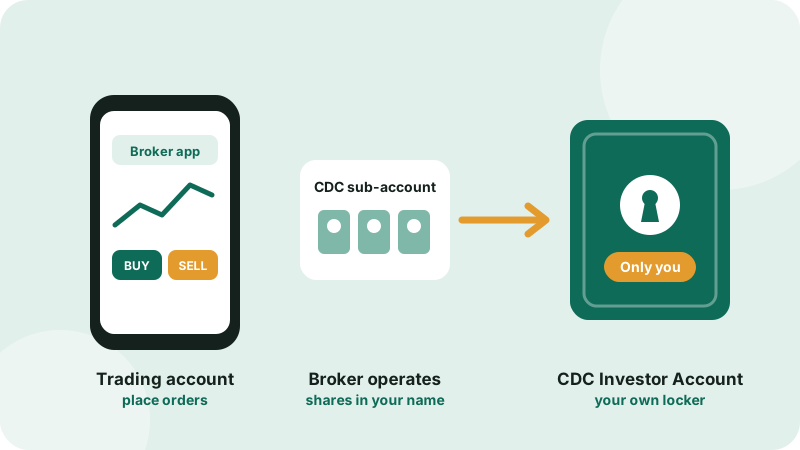
When people start investing on the Pakistan Stock Exchange, they hear three terms that sound alike: trading account, CDC sub-account and CDC Investor Account. Many investors assume they are the same thing. They are not, and the difference decides one important question: who can move your shares?
This guide explains each account in plain words, shows how they work together with an example, and helps you decide whether you need a CDC Investor Account as well as your broker account. If you are completely new, start with our guide on how to open a stock trading account in Pakistan.
The three accounts at a glance
| Trading (brokerage) account | CDC sub-account | CDC Investor Account (IAS) | |
|---|---|---|---|
| Opened with | A PSX-licensed broker | Opened by the broker for you, at CDC | CDC directly (online or at a CDC office) |
| What it does | Lets you place buy and sell orders; keeps a record of your cash and trades | Holds your shares for trading and settlement | Holds your shares in safekeeping |
| Who operates it | You and your broker | Your broker, on your instructions | CDC, only on your own instructions |
| Holds cash? | Yes, your cash balance sits with the broker | No, shares only | Shares only (a small cash balance for CDC fees) |
| Can you trade from it? | Yes | Yes, this is where trades settle | Not directly; move shares to your sub-account first, or use Direct Settlement Service |
| Required? | Yes, to trade | Yes, opened automatically with your trading account | Optional, but recommended by PSX |
The trading account: your door to the market
Only licensed brokers (also called securities brokers or TREC holders) can place orders on the PSX. So to buy any share, you need a trading account with a broker. Through it you:
- deposit money to buy shares,
- place buy and sell orders through the broker's app, website or dealer,
- receive sale proceeds and dividends credited by the broker, and
- get contract notes and account statements.
Think of the trading account as the shop counter: it is where you do business, but it is not where your shares are stored.
The CDC sub-account: where your shares sit by default
Pakistan's shares are held electronically at the Central Depository Company (CDC), not on paper. When you open a trading account, your broker automatically opens a CDC sub-account in your name under the broker's own "participant" account at CDC.
The shares in it belong to you and are recorded in your name. But the account is operated by your broker, because the broker needs to deliver shares when you sell and receive them when you buy. You give the broker authority to do this when you sign the account opening forms.
In normal circumstances this works smoothly. The weakness is control: because the broker can move shares out of the sub-account, an investor depends on the broker's honesty and systems. In the past, a small number of Pakistani brokers misused clients' shares or defaulted, which is why CDC and PSX built extra safeguards such as SMS alerts and the Investor Account.
The CDC Investor Account: your own locker at CDC
A CDC Investor Account is offered through CDC's Investor Account Services (IAS). It is opened directly with CDC, in your name, and no broker is in the chain of control. Shares in it can be moved only when you, the account holder, give CDC an instruction.
A simple comparison: the sub-account is like keeping your valuables at a jeweller's shop where you buy and sell gold. It is convenient, but the shop keeps the keys. The Investor Account is like a bank locker in your own name: only you hold the key, and nobody else can open it.
PSX itself states on its investor-safety page that a CDC Investor Account is more secure than a sub-account and is the preferable option, because securities can only move once you give a transaction order.
How it works in practice: an example
Hina, a schoolteacher in Multan, opens a trading account with Saffron Securities (a fictional broker) and buys 500 shares of a cement company. On settlement day the shares arrive in her CDC sub-account, and she gets an SMS from CDC.
She plans to hold them for five years, so she also opens a CDC Investor Account online. She then moves the 500 shares from her sub-account to her Investor Account. From now on, Saffron Securities cannot move those shares at all.
Three years later, Hina wants to sell 200 shares. She instructs CDC (through its online portal) to transfer 200 shares back to her sub-account with Saffron Securities. Once they arrive, she places the sell order with her broker as usual. The other 300 shares stay safely in her Investor Account.
Some investors skip the transfer step by using CDC's Direct Settlement Service (DSS), which lets Investor Account holders settle trades executed through a broker directly from their Investor Account. The broker only executes the order; the shares never sit in a sub-account. DSS is used, for example, by many overseas Pakistanis investing through Roshan Digital Accounts.
Pros and cons of a CDC Investor Account
| Advantages | Disadvantages |
|---|---|
| Only you can move your shares, so there is no risk of a broker misusing them | Selling takes an extra step: move shares to your sub-account first (unless you use DSS) |
| Your holdings stay safe and separate if your broker shuts down or defaults | CDC charges a modest annual fee and small fees for each transfer |
| Bonus shares and other corporate actions are credited directly into the account | Not practical for frequent trading or day trading |
| You can switch brokers easily, as your long-term holdings are not tied to any one broker | One more login and account to keep track of |
What about your cash?
This is a point many investors miss: a CDC Investor Account protects shares, not cash. Money you deposit with your broker, and sale proceeds sitting in your trading account, remain with the broker. A sensible habit is to keep only the cash you need for your next purchases with the broker, and ask for sale proceeds to be paid to your bank account promptly.
What does a CDC Investor Account cost?
CDC does not charge for opening the account itself, but it collects an annual fee plus small charges for transfers and some other transactions, as set out in its Schedule of Fees (most recently updated in August 2026). Under recent schedules, the annual fee for the first year has been waived. Fees can be paid online through your bank's app using 1Bill. Always check CDC's latest schedule before opening, as charges change from time to time.
How to open a CDC Investor Account
- Complete KYC. Since the centralised KYC system run by NCCPL, every investor completes one KYC process. If you already have a broker account, you may already have it.
- Apply online or in person. Individuals can apply online through CDC's customer portal (CDC Access) without visiting an office, or at CDC offices.
- Keep these ready: your CNIC (or NICOP for overseas Pakistanis), bank IBAN in your own name, email address and mobile number. Joint accounts of up to four people and accounts for minors (through a guardian) are allowed.
- Verify your identity through CDC's online identity verification session or at a CDC office.
- Pay the annual fee (if applicable) and receive your Investor Account number and online access.
- Link it with your broker by giving your broker the account number, and transfer the shares you want to hold long term.
Which one do you need?
- Everyone who trades needs a trading account (and gets a sub-account with it automatically).
- Long-term investors who buy and hold for months or years benefit most from also having a CDC Investor Account.
- Frequent traders usually keep shares in the sub-account for speed, but should check their CDC holdings regularly.
- Overseas Pakistanis investing through Roshan Digital Accounts typically use an Investor Account with Direct Settlement Service.
Safety checklist for every investor
- Make sure every account is opened in your own name, never in a broker employee's or relative's name.
- Keep your mobile number and email updated with CDC so you receive SMS and email alerts for every share movement.
- Log in to CDC Access every month and compare your CDC holdings with your broker's statement. If anything does not match, contact your broker, then CDC and PSX.
- Never share your CDC or broker passwords and one-time codes with anyone.
For more ways to protect your investments, read our guide on how to minimise risk in stock investing.
The bottom line
Your trading account is how you buy and sell. Your CDC sub-account is where your shares sit by default, operated by your broker. A CDC Investor Account is your own locker at CDC, where only you can move your shares. You will always need a broker to trade, but for shares you plan to keep, an Investor Account adds a strong layer of protection for a small yearly cost.
This guide is for education only and is not investment advice. Broker names in examples are fictional. Account rules and CDC fees can change, so confirm the latest details with CDC, PSX or your broker.