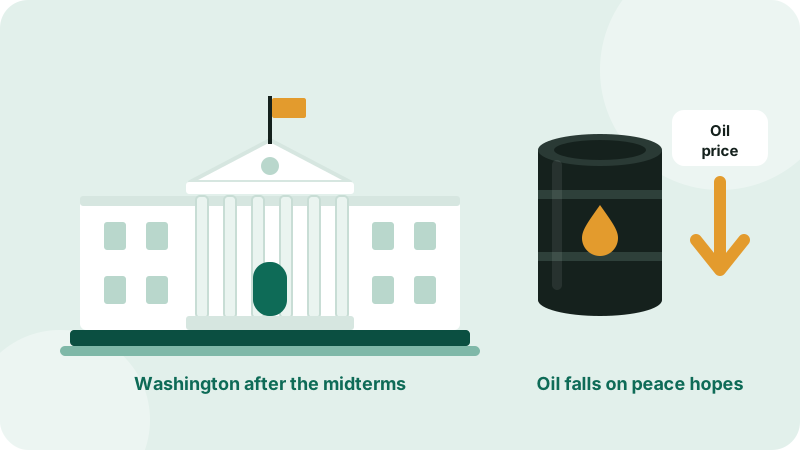
On 3 November 2026, Americans voted in the midterm elections, held halfway through a president's four-year term. All 435 seats in the House of Representatives and 35 Senate seats were contested. According to news reports, the Democratic Party won control of both the House and the Senate, taking them from the Republicans. President Donald Trump, a Republican, remains in office until January 2029, so the United States now faces two years of divided government.
This article is not about who should have won. It is about what this kind of political set-up usually means for the world economy, and how the effects travel to countries like Pakistan.
First, how the US system divides power
- The President runs the government, conducts foreign policy, commands the military and can use certain laws to set trade measures such as tariffs.
- Congress (the House and the Senate) writes laws, approves the budget and all government spending, and can investigate the government through hearings.
- The veto: the President can block laws passed by Congress, and Congress needs a two-thirds majority in both houses to override a veto. That is very hard to achieve.
So when one party holds the White House and the other holds Congress, neither side can easily get its way. Economists often call this gridlock: fewer big new laws, more bargaining, and more fights over the budget.
How markets reacted in the first two days
| Market (4-5 November 2026) | Move | Why, according to analysts |
|---|---|---|
| Oil (Brent and WTI) | Fell more than 8% on 4 November; Brent near $94 a barrel on 5 November | Hopes that a divided Washington speeds up a diplomatic end to the nine-month Iran war |
| US stocks (Dow Jones) | Rose about 3% on 4 November | Relief rally led by companies that benefit from lower energy costs |
| US 10-year bond yield | Eased to about 4.9% | Lower oil means less inflation pressure |
| US dollar index | Near a one-month low | Lower yields make the dollar less attractive |
| Gold | Up about 3% to around $4,066 an ounce | Weaker dollar and lower yields |
| AI chip stocks | Sold off sharply on 5 November, especially in South Korea and Taiwan | Fears of tighter oversight of power-hungry AI data centres |
A word of caution: first-day reactions are often exaggerated. Several strategists reminded investors that markets are driven over time by the business cycle (interest rates, commodity prices, company profits and investment) rather than by elections alone.
What a divided Washington could change
1. The Iran war and oil
The war involving the US and Iran began on 28 February 2026. Throughout the year, Democrats in Congress repeatedly tried to pass "war powers" resolutions to limit military action, but they lacked the votes. With control of Congress, they gain more influence over war funding and more power to hold hearings. A presidential veto still limits what they can force, but analysts expect stronger pressure towards a negotiated settlement. That is why oil fell so sharply.
2. Government spending and borrowing
Every US budget now needs agreement between a Republican President and a Democratic Congress. Research from OCBC Bank notes that this usually means prolonged budget uncertainty, and that compromises can keep government spending and borrowing high, which can push US bond yields up again over time. Budget stand-offs can also raise the risk of temporary government shutdowns.
3. Tariffs and trade
In February 2026 the US Supreme Court ruled against some of the President's emergency tariff powers, and the administration turned to other trade laws instead. A Democratic Congress is expected to challenge tariff policy more actively, but it cannot easily overturn it because of the veto. Expect continued uncertainty rather than a sudden change.
4. Oversight of AI and data centres
Some newly elected members campaigned on the cost and power use of AI data centres. Investors worry this could mean more scrutiny of the huge AI investment boom, which is why chip stocks fell. (See our explainer on Big Tech's $800 billion AI bet.)
What probably will not change much
- The Federal Reserve is independent of Congress. Its decisions depend on inflation and jobs. Futures markets still priced a high chance of another rate hike on 9 December, although some banks, such as Citi, argue that a lasting reopening of the Strait of Hormuz could eventually turn the Fed from hiking towards cutting.
- Foreign policy direction stays mainly with the President.
- The US economy's momentum: growth, company profits and inflation are driven by forces much bigger than one election.
What it means for Pakistan
Cheaper oil, if it lasts
This is the most direct link. Pakistan imports most of its petroleum, and research by PIDE estimates that each $10 fall in the oil price saves roughly $1.8-2 billion a year on the import bill. The effect showed up quickly: from 5 November, the government cut petrol by Rs7.06 to Rs362 per litre and diesel by Rs3.71 to about Rs388. If lower oil prices hold, they would ease inflation, electricity costs and pressure on the current account. (See our explainer on the world's oil cushion.)
A softer dollar
When the dollar weakens globally, pressure on emerging-market currencies, including the rupee, usually eases. It also makes it a little cheaper for Pakistan to service dollar debt.
Gold jumps in rupees
A weaker dollar and lower US yields pushed gold higher. Local gold prices rose by more than Rs20,000 per tola in two days, to around Rs4.3 lakh, a reminder of how closely Pakistani gold prices follow global markets.
Interest rates and the SBP
If oil stays lower and US yields keep falling, the State Bank of Pakistan would have more room to hold or eventually cut its 12% policy rate. If oil rebounds, the opposite applies. The SBP meets on 14 December, five days after the Fed. (Background: the end of cheap money.)
Foreign investors and the PSX
The KSE-100 has been highly sensitive to the Iran conflict all year. In late October, fears of renewed US-Iran tensions after the elections helped push the index lower. A credible path towards peace would generally support Pakistani stocks, especially companies hurt by high energy costs.
What to watch next
- US-Iran talks and whether traffic through the Strait of Hormuz returns to normal.
- The Fed's 9 December decision and the SBP's 14 December decision.
- January 2027, when the new Congress takes office and the first budget negotiations begin.
The bottom line
A divided US government usually means slower, more contested policymaking rather than dramatic reversals. Markets read this result as lowering the risk of a longer war, which pushed oil and the dollar down. For Pakistan, that would be good news: lower fuel prices, less inflation pressure and a steadier rupee. But first reactions often fade, and the real test is whether oil prices stay lower in the weeks ahead. Plan for both outcomes rather than betting on one.
This article explains the economic effects of the election result and does not take a political side. It is for information only and is not investment advice.