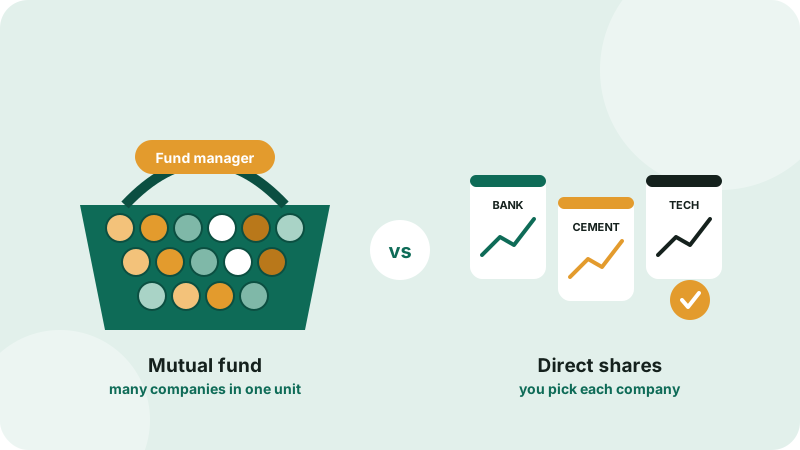
Once you decide to grow your savings through the stock market, the next question is how. You can open a broker account and buy shares of companies yourself, or you can put money in a mutual fund and let a professional do the picking. Both are legal, regulated and widely used in Pakistan. Neither is "best" for everyone.
This guide compares the two side by side in plain words, with rupee examples, so you can choose what fits your money, time and temperament.
What is a mutual fund?
A mutual fund collects money from thousands of investors and invests it as one large pool in shares, government securities, bank deposits or a mix, depending on the fund type. In return, you receive units of the fund.
Think of it like a shared tiffin service. Instead of every family cooking separately, many families pay a professional cook who buys ingredients in bulk and prepares a balanced meal for all. You get a share of the meal in proportion to what you paid, and you pay the cook a fee for the service.
Key terms:
- Asset Management Company (AMC): the licensed company that runs the fund, such as a fund house linked to a bank.
- NAV (Net Asset Value): the value of one unit, calculated every working day. If the fund's investments rise, the NAV rises.
- Trustee: an independent body (in Pakistan usually the Central Depository Company) that holds the fund's assets, so the AMC cannot simply take investors' money.
- Regulator: all mutual funds are regulated by the Securities and Exchange Commission of Pakistan (SECP).
Types of mutual funds in Pakistan
| Fund type | Invests mainly in | Risk | Suits |
|---|---|---|---|
| Money market fund | Treasury bills, bank deposits | Low | Emergency savings, parking cash |
| Income / debt fund | Government bonds, corporate debt | Low to medium | Steady returns over 1-3 years |
| Asset allocation / balanced fund | A mix of shares and debt | Medium | Medium-term goals |
| Equity (stock) fund | Shares of listed companies | High | Long-term growth (5+ years) |
| Index fund / ETF | Shares that track an index such as the KSE-100 | High | Low-cost, hands-off stock exposure |
| Voluntary Pension Scheme (VPS) | Sub-funds of equity, debt and money market | Varies | Retirement saving, with tax benefits |
Most categories have a Shariah-compliant version as well. Islamic funds now manage more than Rs2 trillion, according to the Mutual Funds Association of Pakistan (MUFAP).
This article mainly compares equity funds with buying shares directly, since both put your money into the stock market.
Buying shares directly: a quick recap
When you buy shares yourself, you open a trading account with a licensed broker, choose companies, decide when to buy and sell, and keep the shares in your CDC sub-account or Investor Account. You receive dividends and bonus shares directly, and every decision is yours. (New to this? Read how to open a stock trading account.)
Side-by-side comparison
| Equity mutual fund | Buying shares directly | |
|---|---|---|
| Who picks the companies | A professional fund manager | You |
| Diversification | Instant: one unit spreads your money over 20-40+ companies | You must buy several companies yourself |
| Minimum amount | Low; many funds accept small amounts and monthly instalments | Enough to buy meaningful lots in several companies |
| Yearly cost | Management fee and other expenses, every year | No yearly fund fee; broker commission and charges on each trade |
| Time and knowledge needed | Low: choose a good fund and review it periodically | High: read results, follow news, track prices |
| Control | None over individual holdings | Full control |
| Selling | Redeem units with the fund house; money usually arrives in a few working days | Sell on the PSX through your broker during market hours |
| Emotional pressure | Lower: you see one NAV, not daily stock swings | Higher: easy to panic-sell or chase tips |
| Upside potential | Close to the market, after fees | Can beat the market, or badly lag it |
The cost question, in rupees
Costs are where many investors get surprised. The SECP caps the management fee a fund can charge: up to 3% a year for equity funds, 1.5% for income funds, 1.25% for money market funds and 0.75% for ETFs and index funds, under rules effective from July 2025. Taxes and other expenses come on top, and together they make up the fund's Total Expense Ratio (TER), which every fund must disclose. Some funds also charge a one-time front-end load when you invest.
Example: Asad invests Rs500,000 in an equity fund with a total expense ratio of 3% a year. That is about Rs15,000 a year in costs, taken quietly from the fund's NAV whether the market goes up or down.
His colleague Mahnoor buys shares of five companies directly with the same Rs500,000 and holds them for the year. She pays broker commission and small regulatory charges when she buys and again when she sells, usually a fraction of a percent of each trade, but no yearly fund fee. Over several years of holding, her costs are likely to be lower than Asad's, as long as she does not trade frequently.
The lesson: funds are not "free". A 2-3% yearly fee matters a lot over 10 or 20 years. That is why low-cost index funds and ETFs are attractive for long-term investors who simply want market returns.
The diversification question
Diversification means not putting all your eggs in one basket. With Rs50,000, buying meaningful amounts of 15 different companies directly is difficult. One unit of an equity fund already spreads your money over dozens of companies across banks, cement, fertiliser, oil and gas, technology and more.
Suppose one company in your portfolio falls 40% after bad results. If it is one of two shares you own, your portfolio drops about 20%. If it is one of 30 holdings in a fund, the hit is closer to 1-2%. (See how to minimise risk in stock investing.)
The knowledge and time question
Picking shares well means reading financial reports, understanding ratios like P/E and EPS, following company results and staying calm when prices fall. If you enjoy this and can give it a few hours a month, direct investing can be rewarding. If you do not have the time or interest, a fund does the work for you.
Be honest about behaviour too. Many direct investors lose money not because of bad companies, but because they buy on tips, panic in falls and sell too early. A monthly investment in a fund removes many of these temptations.
Where Pakistanis actually put their money
According to MUFAP, Pakistan's mutual fund industry managed about Rs4.7 trillion in September 2026, up around 12% in a year, with individual investors holding about 43% of assets. But only a small share, roughly 13% in early 2026, was in equity funds. Most money sits in money market and income funds, which behave more like high-yield savings than stock investments. So when someone says "I invest in mutual funds", check which kind.
Which is right for you? A quick checklist
A mutual fund is likely better if you:
- are starting with a small amount or want to invest monthly from your salary;
- do not have time to research companies;
- want built-in diversification and professional management;
- tend to get nervous watching daily price moves.
Buying shares directly may suit you if you:
- enjoy learning about companies and can study results regularly;
- have enough capital to spread over at least 8-10 companies in different sectors;
- want full control and to avoid yearly fund fees;
- can hold through falls without panic selling.
The middle path: use both
Many experienced investors use a core and satellite approach. The core, perhaps 70-80% of stock-market money, goes into a low-cost equity fund, index fund or ETF for steady market returns. The satellite, the remaining 20-30%, is used to buy a few companies you have researched well. You learn by doing, without betting everything on your own picks. Building both gradually, rather than all at once, also helps (see why not to invest all your money at once).
How to start with a mutual fund
- Choose a fund house (AMC) licensed by the SECP. Most large banks have one, and there are independent AMCs too.
- Open an account online through the AMC's website or app using your CNIC and a bank account in your own name, and complete KYC.
- Pick the right fund type for your goal: money market for short-term cash, equity or index funds for long-term growth.
- Read the Fund Manager Report (FMR), published monthly: check returns against the benchmark over several years, the total expense ratio, the risk profile and any front-end load.
- Invest regularly, for example a fixed amount every month, and review once or twice a year rather than daily.
Common myths
- "Mutual funds give guaranteed returns." They do not. Equity funds can lose money, and even past returns of income funds do not guarantee future ones.
- "A fund with a low NAV is cheaper." NAV per unit says nothing about value; a Rs10 unit and a Rs100 unit can be equally good investments.
- "Last year's top fund will be top again." Rankings change often. Look at performance over 3-5 years and at costs.
The bottom line
Mutual funds trade a yearly fee for convenience, diversification and professional management. Direct shares trade time and effort for control and lower ongoing costs. For most beginners, a low-cost equity or index fund is the easier starting point. As your knowledge and savings grow, adding a few carefully chosen shares can make sense. What matters most is starting early, investing regularly and keeping costs low.
This guide is for education only and is not investment advice. Names in the examples are fictional. Fees, caps and industry figures change; check the latest Fund Manager Report and SECP rules before investing.