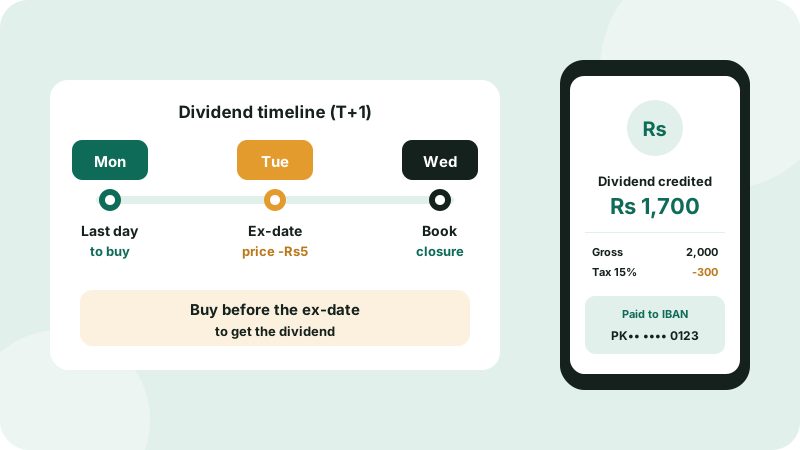
You own a few shares, and one day the news says your company has announced a cash dividend. Then the questions start. Will I get it? When? Why does the notice talk about "book closure"? Why did the share price fall the next week? And why did my friend never get his dividend at all? This guide follows one dividend from the boardroom to your bank account, step by step, with rupee examples.
New to dividends? First read dividend yield explained, which covers what a dividend is and how to compare companies by yield.
First, read the dividend announcement correctly
PSX companies usually announce dividends as a percentage of face value, not of the share price. Most shares have a face value of Rs10, so:
- A 25% dividend = Rs2.50 per share
- A 50% dividend = Rs5.00 per share
- A 150% dividend = Rs15.00 per share
Some companies have a face value of Rs5 or Rs1, so always check the rupee amount in the notice. A "50% dividend" on a Rs120 share is not a 50% return. It is Rs5, about 4% of the price.
You will also see two kinds of cash dividend:
- Interim dividend: declared by the board of directors during the year, usually with quarterly or half-yearly results.
- Final dividend: recommended by the board with the annual results, then approved by shareholders at the Annual General Meeting (AGM). Shareholders can approve or lower it, but they cannot raise it.
Companies post these announcements on the PSX website. Our PSX data portal guide shows you where to find them.
The four dates that matter
Every dividend notice comes with dates. Here is what each one means for you:
| Date | What it means | What you should do |
|---|---|---|
| Announcement date | The board announces the dividend amount and the book closure dates. | Note the book closure start date. |
| Last day to buy | The last trading day on which a purchase still settles in time to reach the register. | Buy on or before this day if you want the dividend. |
| Ex-dividend date (XD) | From this day, the share trades without the right to the dividend. The price usually falls by about the dividend amount. | If you buy on or after this day, the seller gets the dividend, not you. |
| Book closure | The company "closes" its shareholder register for a few days to fix the list of people who will be paid. | Nothing. Trading goes on as usual; only the transfer of ownership on the register pauses. |
After book closure comes the payment date, when the money is credited to your bank account.
Why the ex-date comes before book closure (T+1)
When you buy a share on PSX, it does not become yours on the company's register the same day. The trade settles later, and only then do your CDC account and the register show you as the owner. Since 9 February 2026, PSX trades settle on T+1: one working day after the trade.
So the company and the exchange set the ex-date one working day before book closure starts. A share bought the day before the ex-date settles just in time. A share bought on the ex-date settles too late, after the register has closed.
Many older websites and guides still say the ex-date is "book closure minus 2 days". That rule was for the old T+2 system. Under T+1, the ex-date is book closure minus 1 working day, and the last day to buy is book closure minus 2 working days. Always confirm the ex-date in the PSX notice.
Example: one dividend from start to finish
Ravi Foods Limited (RAVF), a fictional company with a face value of Rs10, announces its annual results with a final cash dividend of 50%, or Rs5 per share. The AGM is on 22 December 2026, and the share register will be closed from 16 to 22 December.
| Day | What happens |
|---|---|
| Thu 26 Nov | The board announces the Rs5 dividend and the book closure dates. |
| Mon 14 Dec | Last day to buy. RAVF closes at Rs120. |
| Tue 15 Dec | Ex-dividend date. RAVF starts trading around Rs115 (Rs120 minus the Rs5 dividend). |
| Wed 16 – Tue 22 Dec | Book closure. Shareholders approve the dividend at the AGM on 22 December. |
| Early January | The dividend, after tax and Zakat, is credited to shareholders' bank accounts. |
Now look at three investors:
- Kamran buys 400 shares on Monday 14 December. His trade settles on Tuesday, before book closure. He gets the dividend.
- Saima buys 400 shares on Tuesday 15 December, the ex-date. Her trade settles on Wednesday, when the register is already closed. She does not get the dividend, but she paid about Rs5 less per share.
- Usman owned RAVF for years and sells all his shares on Tuesday 15 December. His sale settles after the register closed, so he is still on the list. He gets the dividend even though he no longer owns the shares.
The rule to remember: own the share before the ex-date to get the dividend. Selling on or after the ex-date does not take it away.
How much actually reaches your account?
The company does not pay you the full dividend. It deducts income tax and, where it applies, Zakat, pays those to the government, and sends you the rest.
- Income tax (Section 150): for most listed companies, 15% if you are on FBR's Active Taxpayers List (a filer) and 30% if you are not. For individuals this is usually the final tax on that dividend.
- Zakat: for Muslim Pakistani shareholders, 2.5% of the face value of your shares is deducted from the dividend, unless you have submitted a Zakat exemption declaration (form CZ-50).
Here is Kamran's Rs5 dividend on 400 shares (gross dividend Rs2,000):
| Kamran's status | Gross dividend | Income tax | Zakat | Net in his bank |
|---|---|---|---|---|
| Filer, Zakat deducted | Rs2,000 | Rs300 (15%) | Rs100 | Rs1,600 |
| Filer, CZ-50 submitted | Rs2,000 | Rs300 (15%) | Rs0 | Rs1,700 |
| Non-filer, Zakat deducted | Rs2,000 | Rs600 (30%) | Rs100 | Rs1,300 |
| Non-filer, CZ-50 submitted | Rs2,000 | Rs600 (30%) | Rs0 | Rs1,400 |
Zakat here is 400 shares × Rs10 face value × 2.5% = Rs100. Just by being a filer, Kamran keeps Rs300 more from this one dividend.
A few special cases have different rates. Dividends from power producers (IPPs), from companies that pay no tax because of exemptions or losses, and from mutual funds are all taxed differently. Mutual fund payouts, for example, are taxed at 15% on the part earned from shares and 25% on the part earned from debt. The company's dividend notice usually states the rates that apply.
The ex-date price drop, and the "dividend capture" myth
Some new investors think: "I'll buy the day before the ex-date, collect the dividend, and sell the next day." It sounds clever, but it doesn't work.
Kamran's 400 RAVF shares were worth 400 × Rs120 = Rs48,000 on Monday. On the ex-date the price drops to about Rs115, so they are worth about Rs46,000. His holding lost Rs2,000 in value, and he will receive only Rs1,600 to Rs1,700 after tax and Zakat. On paper he is Rs300 to Rs400 worse off, before brokerage on the buy and sell.
The drop on the ex-date is mechanical. It is not bad news about the company. Over time, a good company can recover that drop as it keeps earning profits, which is why dividends reward long-term holders, not people trying to time a few days.
Why your IBAN decides whether you get paid
Under Section 242 of the Companies Act, 2017, a listed company must pay cash dividends only electronically, directly into the bank account each shareholder has registered. Cheques and dividend warrants are no longer used for listed companies.
That account is identified by your IBAN (International Bank Account Number). A Pakistani IBAN has 24 characters and starts with "PK", for example: PK12 ABCD 0001 2345 6789 0123 (a made-up number). You can find yours in your banking app, on your cheque book, or by asking your branch.
If your IBAN is missing, incomplete or wrong, or your CNIC on record is missing or expired, the company holds back (withholds) your dividend. Company notices on the PSX website regularly report hundreds of shareholders whose dividends were held back for exactly this reason.
Where to register or update your IBAN
| Where your shares are held | Who updates your IBAN |
|---|---|
| CDC sub-account through your broker (most investors) | Your broker. Ask them to update the bank details on your CDC sub-account. |
| CDC Investor Account (IAS) | CDC directly, through its investor services. |
| Physical share certificates (old holdings) | The company's share registrar, using a dividend mandate form and a copy of your CNIC. |
Not sure which of the first two you have? See trading account vs CDC Investor Account.
A few practical tips:
- Use a bank account in your own name. For a joint share account, the dividend goes to the main holder's bank account.
- When your CNIC is renewed, send the new copy to your broker or CDC so your record stays valid.
- If you change banks, update the IBAN before the next book closure, not after.
What if my dividend was held back?
The money is not lost straight away. The company keeps the withheld dividend and releases it once you supply a valid IBAN and CNIC. Contact your broker (or CDC, or the share registrar for physical shares), update your details, and then ask the company's share registrar to release the withheld amount.
Don't leave it for years. If a dividend stays unclaimed for a long time, the law allows the company to eventually hand it over to the government, and getting it back then becomes a much longer process.
When will the money arrive?
SECP's dividend regulations give companies a short, fixed deadline to pay after a dividend is declared, traditionally 15 working days. For a final dividend, the clock starts from approval at the AGM; for an interim dividend, from the board's declaration. In practice, most investors see the money in their bank within two to four weeks of book closure.
To check what you were paid, register on CDC's eServices portal. Its Centralized Cash Dividend Register (CCDR) shows every cash dividend paid to you or withheld, along with the tax and Zakat deducted. It is also handy at tax-return time.
What about bonus shares?
A bonus share (stock dividend) works with the same dates: you must own the share before the ex-bonus date. Instead of cash, extra shares are credited to your CDC account. Tax is collected differently: under Section 236Z, the company holds back 10% of your bonus shares (20% for non-filers) until the tax on them is paid. Read more in stock dividends and bonus shares explained.
Your dividend checklist
- Read the announcement and convert the percentage into rupees per share.
- Find the ex-date in the PSX notice. Buy before it, not on it.
- Make sure your IBAN and valid CNIC are registered with your broker or CDC.
- Check that you appear on FBR's Active Taxpayers List, so you pay 15% tax instead of 30%.
- If you are exempt from Zakat, submit a CZ-50 declaration before book closure.
- Expect the share price to drop by about the dividend on the ex-date. That is normal.
- After payment, confirm the credit in your bank and on CDC's eServices portal.
This guide is for education only and is not investment or tax advice. Ravi Foods and all investors in the examples are fictional. Tax rates are as reported for tax year 2027 (1 July 2026 to 30 June 2027) and can change with each Finance Act; check FBR's current withholding tax rate card and each company's dividend notice.