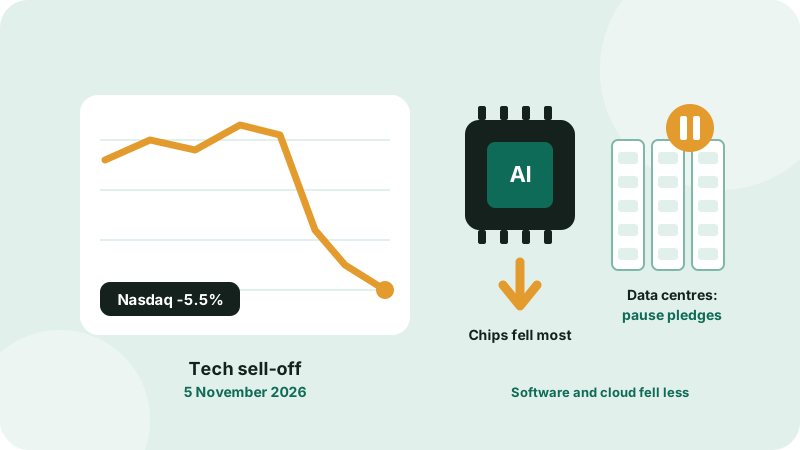
For two years, artificial intelligence has been the engine of the US stock market. Companies that make AI chips, build data centres and sell cloud computing have delivered huge gains. Then, in the week of the 3 November 2026 US midterm elections, that engine stalled. After President Trump's Republican party lost control of both houses of Congress, a sharp sell-off swept through technology shares.
This article explains, without taking political sides, what happened, which companies were hit, why investors reacted so strongly, and what lessons it holds for investors in Pakistan.
What happened, day by day
| Day | What markets did |
|---|---|
| Tuesday 3 Nov | Election day. Democrats won both the House and the Senate, plus several key governorships. |
| Wednesday 4 Nov | The Dow jumped about 3% as oil fell on hopes of an earlier end to the Iran war. But beneath the surface, data-centre suppliers were already falling: power company Vistra dropped 14% and equipment maker Vertiv 13%. |
| Thursday 5 Nov | The sell-off spread. The Nasdaq fell 5.5% into "correction" territory, the S&P 500 fell 4.4% and the Dow lost about 1,800 points. Roughly $2.5 trillion of value disappeared in a day. |
| Friday 6 Nov | Markets steadied somewhat as a strong US jobs report came in, but investors stayed cautious. |
The Philadelphia Semiconductor Index, which tracks chip companies, fell more than 12% on Thursday, its worst day since the start of the Covid crash in March 2020.
Which companies fell, and by how much (5 November)
| Group | Examples | Approximate fall |
|---|---|---|
| AI chipmakers | Nvidia, Broadcom, AMD, Micron | Nvidia about 9%; Broadcom about 9-10%; AMD and Micron 14-16% |
| Servers and networking | Dell, Cisco | Dell about 13%; Cisco about 6% |
| Data-centre operators | IREN, Applied Digital, Nebius | More than 14% each |
| Software and cloud | Oracle, Microsoft, Salesforce, Snowflake | Oracle 7-8%; Microsoft about 3%; Salesforce 3.6%; Snowflake 6.4% |
| Big consumer tech | Meta, Amazon, Apple | Meta 3.4-4.4%; Amazon about 2.4%; Apple about 1.7% |
To put the scale in perspective, Nvidia alone lost about $374 billion in market value in one day, equal to roughly four-fifths of Pakistan's entire annual economic output. Microsoft's value fell by about $117 billion. Design-software company Figma dropped 17% even though it had just reported stronger-than-expected results, a sign that investors were selling the whole theme, not judging individual businesses.
Why did a US election hit tech stocks?
1. Voters turned against data centres
AI runs in giant buildings called data centres, packed with chips that use enormous amounts of electricity and water. In many US communities, people blamed them for higher power bills, strain on the grid and too few local jobs. This became a major campaign issue. According to an NBC exit poll, more than half of voters said AI and data centres were a crucial or major factor in their vote.
2. Key states elected sceptical governors
Democratic candidates who campaigned on pausing or tightening rules for data centres won the governorships of Texas, Ohio and Georgia. These three states host nearly half of the US AI data-centre build-out, and Texas alone accounts for about 27% of planned capacity, according to Wells Fargo. Governors can influence permits, electricity rules and tax breaks, which matter a lot for where data centres get built.
3. Local votes went the same way
Close to 40 local ballot measures restricting data-centre development passed, mostly in Ohio and Illinois. A tracker run by Data Center Watch found that 32 of the 34 winning governors in called races supported stronger regulation or restrictions. Some prominent politicians went further: Senator Bernie Sanders called for a national moratorium on data centres.
4. The AI boom was already priced for perfection
Big Tech is spending more than $800 billion on AI infrastructure in 2026 (see our explainer on Big Tech's AI bet). Chip and data-centre shares had risen enormously on the assumption that this spending would keep growing fast. Any threat of slower construction hits those expectations directly. Nvidia's shares had already fallen about 15% over the previous three months, so investors were nervous even before the election.
Why chips fell more than software
A pattern stands out in the table: the companies that supply data-centre construction (chips, servers, power equipment, data-centre operators) fell the most. The big software and cloud companies that pay for the build-out fell much less.
Analysts call this a possible "K-shaped" AI trade. Tighter rules could make new data centres harder to build. That hurts suppliers whose sales depend on constant new construction, and smaller, debt-funded companies racing to catch up. But giants like Microsoft, Amazon and Google, which already own large amounts of computing capacity, could even gain an advantage if new competitors find it harder to build.
A simple comparison: imagine a city suddenly restricts new building permits. Cement, steel and construction companies suffer first, because their business depends on new projects. But the owners of existing buildings may find their property becomes more valuable, because new supply is limited. Chipmakers are the cement companies of AI; the cloud giants are the building owners.
How much can new politicians actually change?
- Congress can hold hearings and pass laws, but President Trump, who strongly supports AI and the data-centre build-out, is expected to veto federal restrictions, and overriding a veto needs a two-thirds majority.
- States are where real change is more likely, through permits, utility rules and tax incentives, though some steps need approval from state legislatures.
- Timing matters: new governors and the new Congress take office in January 2027, so any rules will take months to appear.
Morgan Stanley suggested the result could split the US into areas open to new data centres and areas without them, rather than stopping the build-out entirely. Data-centre companies may shift projects to friendlier states, or build their own power supply.
Overreaction or turning point?
Opinions differ, and it is too early to know.
- "A knee-jerk reaction": Truist's chief investment officer described the moves as more of a reflex than a real guide to how tech will perform. AMD's chief executive, Lisa Su, said markets can be "a little bit short-sighted" and that underlying AI demand remains strong.
- "A referendum on AI": an Amundi strategist argued the elections were more a vote on AI than on Mr Trump, pointing to a lasting shift in public mood that companies will have to address, for example by paying for their own power.
- "Letting air out of a bubble": some economists argued that political pushback could slow an overheated boom without bursting it, which might be healthier in the long run.
What it means for Pakistan
Global risk mood
When US tech stocks fall sharply, global investors often become more cautious about all riskier markets, including emerging markets like Pakistan. Asian tech-heavy markets fell hardest on 5 November: South Korea's Kospi and Japan's Nikkei each dropped about 6%, and Taiwan about 4.5%.
IT exports and freelancers
Pakistan's IT exports reached a record of about $4.6 billion in FY26, much of it to the United States. A slowdown in AI spending would mainly hit hardware and construction, but if US tech companies tighten budgets, demand for some outsourced software work could soften. On the other hand, companies trying to get more from existing AI investments may still need software development, integration and support, areas where Pakistani firms compete.
Oil and inflation
The same election result pushed oil prices down on hopes of an earlier end to the Iran war, which is good news for Pakistan's import bill. (See what a divided Washington means for oil and rates.)
A lesson for every investor
The biggest lesson is about concentration risk. Investors who put most of their money into one exciting theme, whether AI in America or a single hot sector on the PSX, can lose a large share of it in days when sentiment turns. Spreading investments across sectors and buying gradually reduces that risk. Read our guides on how to minimise risk and why not to invest everything at once.
What to watch next
- Whether new governors in Texas, Ohio and Georgia announce actual pauses or new rules after taking office in January 2027.
- Big Tech's next spending plans: any cut to 2027 data-centre budgets would be a major signal.
- Nvidia's next quarterly results, which investors use as a health check on AI demand.
- The Federal Reserve's 9 December rate decision, which affects how much investors are willing to pay for growth stocks.
The bottom line
The post-midterm tech crash was less about any single company and more about one question: will America keep building AI data centres as fast as investors assumed? Voters in key states signalled they want limits, and the companies most dependent on new construction were punished hardest. Whether this becomes a lasting turning point or a temporary scare will depend on what new officials actually do in 2027. For investors anywhere, it is a powerful reminder that even the strongest trends can reverse quickly.
This article explains market events and does not take a political side. Company names are mentioned for news context only. It is for information only and is not investment advice.