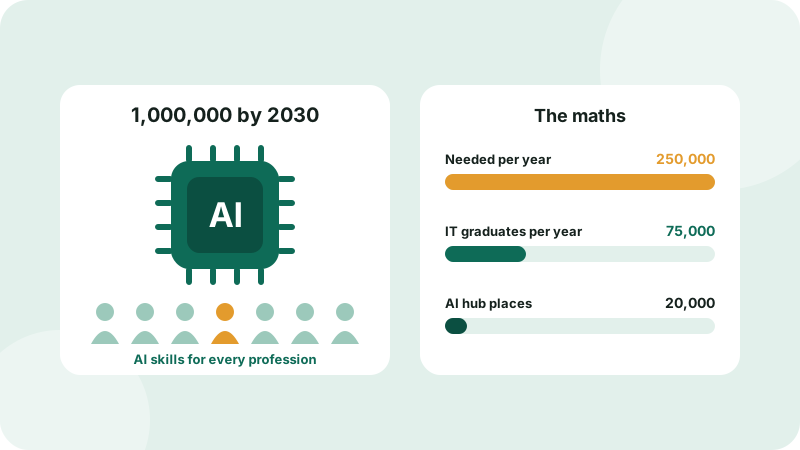
Artificial intelligence is changing how the world works, and Pakistan wants a share of it. On Thursday, 5 November 2026, Federal Minister for Planning, Development and Special Initiatives Ahsan Iqbal told a Pakistan-Russia technology forum in Islamabad that Pakistan aims to develop one million AI professionals by 2030, and that seven new AI centres will link research, skills training, startups and industry.
It is a headline-grabbing number. But what does it actually mean? Who counts as an "AI professional"? Can Pakistan get there in four years? And what should a student, a freelancer or an office worker do about it? Here is a plain-language explanation.
Where the target comes from
The one-million figure is not new. It comes from Pakistan's first National Artificial Intelligence Policy 2025, which the federal cabinet approved on 30 July 2025. The policy sets out how the government wants to use AI in public services, education, agriculture and business, and it lists a set of targets to reach by 2030:
| Target under the National AI Policy | Goal |
|---|---|
| People trained in AI | 1 million by 2030 |
| AI scholarships | 3,000 a year |
| Locally developed AI products | 1,000 |
| AI-powered civic (public service) projects | 50,000 |
| AI trainers | 10,000 |
| Internships | 20,000 a year |
| Funding | An AI Innovation Fund and an AI Venture Fund to support private companies |
| Centres of Excellence in AI | In major cities, with smaller hubs around them |
The minister repeated the target this week while discussing technology partnerships with Russia. He also linked it to the government's broader URAAN Pakistan economic plan, which aims for a $1 trillion economy by 2035, with "e-Pakistan" (the digital economy) as one of its five pillars.
What does "AI professional" really mean?
This is the most important question, and the official statements give two different pictures.
- The cabinet announcement and this week's speech say "AI professionals". That sounds like people who build AI systems: data scientists, machine-learning engineers and AI researchers.
- In September 2026, speaking at a forum in Urumqi, China, the same minister described the target as giving AI skills to one million "non-IT" professionals by 2030. He also said the seven AI hubs will offer about 20,000 training places.
Put together, the plan is best understood as mass AI upskilling. Most of the one million would be doctors, accountants, teachers, marketers, farmers' advisers, bank staff and government employees learning to use AI tools in their own work. A much smaller group would be specialists who design and build AI systems. That distinction matters: training a million people to use AI well is hard but possible; producing a million AI engineers by 2030 would not be.
Do the numbers add up?
Here is the simple maths:
From late 2026 to 2030 is roughly four years. To reach 1,000,000 people, Pakistan needs about 250,000 trained people every year.
The minister said Pakistan produces more than 75,000 IT graduates a year. Even if every one of them became an AI specialist, that would be only about 300,000 by 2030, less than a third of the target.
The seven AI hubs offer about 20,000 places, about 2% of the goal.
So universities and the new hubs alone cannot get there. The bulk would have to come from short courses, online training and workplace upskilling. Pakistan does have experience of training at this scale: the minister said the government's free online DigiSkills programme has recorded more than 4.5 million enrolments. That shows huge demand for digital skills. The harder part is making sure training leads to real ability and real jobs, not just certificates.
Why the government cares: the IT export story
Pakistan earns badly needed dollars from technology. According to State Bank data, IT and IT-enabled services exports reached a record $4.6 billion in fiscal year 2025-26, up about 21% from $3.8 billion the year before. Freelancers contributed about a quarter of that. It is now the country's largest services export.
But the sector still missed the government's $5 billion target, and much of its income comes from relatively low-cost services: coding for foreign clients, call centres and outsourced back-office work. The minister said Pakistan needs to move beyond exporting IT services toward building its own products and digital platforms for global markets.
Global demand for AI is booming: the world's biggest tech companies plan to spend hundreds of billions of dollars on AI this year (see our explainer on Big Tech's $800 billion AI spending). If Pakistan can supply skilled AI workers and products, even a small slice of that spending would be worth billions of dollars a year. But the AI boom also has its ups and downs, as the recent US tech stock sell-off showed, so the opportunity is not guaranteed.
AI skills also matter at home. If government departments, banks, hospitals and farms use AI well, they can work faster and serve people better, which is the aim of the policy's 50,000 civic projects.
What it means for you
If you are a student
For computer science and engineering students, AI and data skills are quickly becoming the baseline employers expect, not a bonus. For everyone else, knowing how to use AI tools for research, writing, analysis and presentations is becoming as basic as knowing Excel. Look out for the policy's promised scholarships and internships, and for the new AI centres when they open.
If you are a freelancer
Many freelance jobs, like writing, design, video editing, data entry and basic coding, are being changed by AI tools. Freelancers who use AI to work faster and offer better results can charge more. Those who don't use it may find that clients pay less for work AI can partly do.
If you work in a non-IT job
This is the group the target is largely aimed at. An accountant who can use AI to check reports, a teacher who uses it to prepare lessons, or a shopkeeper who uses it for online marketing can all gain an advantage without becoming a programmer.
Free training you can look for
The government already runs several free programmes. Course lists and intake dates change, so always check the official websites:
- DigiSkills.pk: free online courses in freelancing, digital marketing and other digital skills, including AI-related topics.
- NAVTTC "Skills of Tomorrow" (under the Prime Minister's Youth Programme): free three-month courses such as AI for Everyone, AI Financial Analyst with Power BI and AI-powered e-commerce, offered at training centres across the country. Applications are made through NAVTTC's skills portal.
- NAVTTC partnerships with private companies: for example, sponsored training in AI, big data and cybersecurity with NETSOL's AI institute.
Government training programmes are free. Be careful of fake websites, WhatsApp messages or social media pages that ask for a "registration fee" or bank details to join a "government AI course". Apply only through official websites.
If you invest
Pakistan's listed technology companies could benefit if AI raises demand for local software and services, and the policy's Innovation and Venture Funds may support new startups. But government targets do not automatically translate into company profits. Judge each company on its own earnings and orders.
The challenges
- Unclear definition: without a clear definition of an "AI professional", it will be hard to judge whether the target has been met. A short online course and a master's degree should not count the same.
- Funding: the policy promises funds and centres, but sustained spending is needed in a country under tight IMF budget limits.
- Quality over numbers: employers need people who can actually solve problems with AI, not just people with certificates.
- Infrastructure: affordable, reliable internet and electricity, and access to computing power, are basic requirements for AI work.
- Brain drain: many of Pakistan's best tech graduates move abroad for higher pay. Training more people helps only if enough of them build careers and companies at home.
- Payments: freelancers and tech firms still face problems receiving international payments. At the Russia forum, the minister himself called payment and settlement mechanisms a "practical challenge".
The bottom line
"One million AI professionals by 2030" is best understood as a push to spread AI skills widely across Pakistan's workforce, not to produce a million AI engineers. The target is very ambitious, and its success will depend on funding, the quality of training and whether it leads to real jobs and exports. For individuals, though, the message is clear: AI skills are becoming valuable in almost every career, and some good training is already available for free.
This article is for information and education only and is not investment or career advice. Training programmes and their dates change often; check official websites for the latest details.