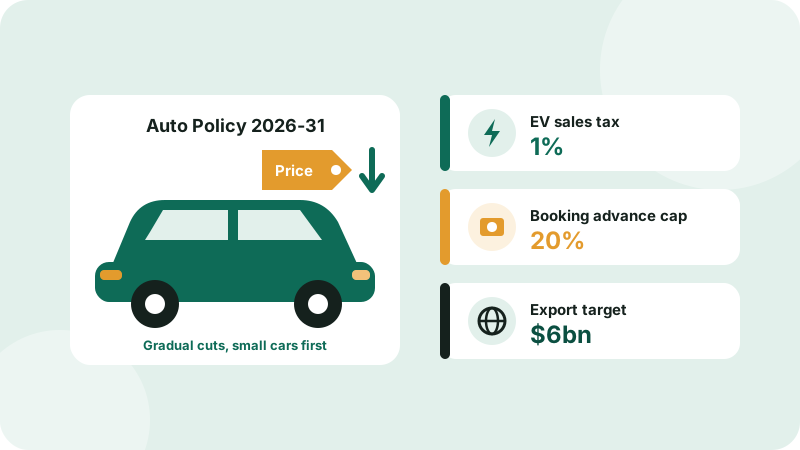
On Saturday, 7 November 2026, the Prime Minister's Adviser on Industries and Production, Haroon Akhtar Khan, and Information Minister Attaullah Tarar held a press conference in Islamabad to unveil Pakistan's new Auto Policy 2026-31. Prime Minister Shehbaz Sharif has approved the final draft, and Akhtar said car prices "will come down gradually".
Many headlines say the policy is "approved", but it is not yet in force. It now goes to the federal cabinet. The electric vehicle tax breaks need the IMF's agreement, and the new levy needs a law, which the government aims to pass by December 2026. The full policy document is expected to be released next week.
Here is what is proposed, in plain words, and what it could mean for car buyers, people thinking about an electric car, investors and the economy.
Why Pakistan needs a new auto policy
The previous five-year plan, the Auto Industry Development and Export Policy 2021-26, expired on 30 June 2026. Since then, the industry has been waiting for new rules.
Pakistan's car industry has long been protected by very high import duties. That protection helped local assembly plants survive, but buyers have paid for it in high prices, long delivery queues and "on-money" (the extra premium dealers charge for quick delivery). Exports have barely grown. The adviser himself admitted that the country had been making auto policies for ten years without any increase in exports. Last fiscal year, the sector exported only about $200 million.
Meanwhile, demand has bounced back. According to the Pakistan Automotive Manufacturers Association (PAMA), car sales rose 48% to 140,253 units in July 2025 to May 2026, helped by lower interest rates and easier imports. Imported used cars have also taken a big share. The parts makers' association, PAAPAM, estimates that about 50,000 were imported last year, nearly 30% of the market.
The six goals of the policy
Akhtar said the policy is built around six priorities:
- Affordable vehicles, especially small cars for middle and lower-middle income families
- Exports, turning a protected local industry into one that sells abroad
- Localisation, making more parts in Pakistan instead of just assembling imported kits
- Safety, with stricter international standards for vehicles
- Electric mobility, to cut Pakistan's expensive fuel import bill
- Transparency, including fairer treatment of car buyers
The main measures at a glance
| Area | What is proposed |
|---|---|
| Import duties | Customs duties on imported parts, raw materials and completely knocked-down (CKD) kits cut gradually over five years. Duties on fully built imported cars also reduced, with the extra regulatory and additional duties phased out. |
| Car bookings | Carmakers can take at most 20% of a car's price as an advance at booking. |
| Electric vehicles | Sales tax of 1% for battery EVs, 6% for range-extended EVs and 9% for plug-in hybrids, for vehicles under about $50,000. Lower taxes on charging equipment. |
| EV financing | Loan limit raised to Rs10 million, repayment up to five years (from three). |
| Exports | Mandatory export targets for carmakers, about $6 billion in total over five years. 5% rebate on exports plus 10% on export growth. Penalties for missing targets. |
| Localisation | Minimum local-content targets. Companies that miss them lose their incentives. |
| Safety and quality | 45 additional vehicle standards, independent third-party audits and a planned automotive testing institute. |
| New levy | An Automotive Development Levy on petrol and diesel vehicles above 1,000cc, to fund EV incentives, export rebates and research. |
Will car prices really fall?
Some may, slowly, but not all, and not straight away.
Duty cuts on imported parts, kits and raw materials lower the cost of making a car in Pakistan. The government says these cuts are aimed at smaller vehicles bought by middle and lower-middle income families, and that luxury vehicles will not get the same relief. Lower import duties on fully built cars also add competition, which pushes local assemblers to keep prices in check.
Three things work against a big price drop:
- The cuts are spread over five years, so any effect on prices will come gradually, not overnight.
- The new levy on petrol and diesel cars above 1,000cc could cancel out the savings on mid-size and larger cars, or even make them costlier.
- Other costs still matter. The rupee exchange rate, the 18% general sales tax, energy costs and interest rates all affect car prices, and the policy doesn't control them.
In short, buyers of small cars under 1,000cc have the best chance of seeing lower prices over time. For bigger petrol cars, the levy may mean little or no relief.
The 20% booking advance cap: a direct win for buyers
Today, buyers often pay most or all of a new car's price up front, then wait months for delivery while the carmaker holds their money. Under the new rule, carmakers could ask for no more than 20% of the price at booking.
Example: Nadia books a car priced at Rs4,000,000. Under the 20% cap, the maximum advance is Rs800,000. The other Rs3,200,000 stays in her own savings account, earning profit, until the car is nearly ready. If she had to pay the full price up front and wait four months, she would lose the profit on that money for the whole period.
The government also says the cap targets "on-money". When carmakers can't collect huge advances, there is less room for speculators to book cars only to resell the delivery slots at a premium.
Electric vehicles: much lower tax, if the IMF agrees
The biggest tax changes are for electric vehicles:
| Vehicle type | Proposed sales tax |
|---|---|
| Battery electric vehicle (BEV), fully electric | 1% |
| Range-extended EV (electric drive with a small petrol generator) | 6% |
| Plug-in hybrid (PHEV) | 9% |
| Standard rate on most goods, for comparison | 18% |
These rates would apply only to vehicles priced below about $50,000. Qualifying EVs would also be exempt from federal excise duty, withholding tax and capital value tax. Sales tax on charging equipment would fall to 1% with no customs duty, and the government plans support for building charging stations.
Illustration: on an electric car worth Rs6,000,000 before sales tax, 18% sales tax would be Rs1,080,000, while 1% is Rs60,000, a difference of over Rs1 million. Actual showroom prices depend on the full tax structure and on what each company chooses to pass on.
Two cautions. First, the EV tax breaks need IMF approval, and the IMF generally opposes special tax exemptions, so the final rates could change. Second, EVs are still rare in Pakistan: last year's sales boom was almost entirely petrol and hybrid cars. The government's separate EV policy aims for electric vehicles to make up 30% of new sales by 2030, which is a very big jump from today.
The $6 billion export push
The most ambitious part of the policy is exports. Carmakers and parts makers would get mandatory export targets. According to the draft reported by Dawn, these targets rise year by year:
| Fiscal year | Export target (vehicles + parts) |
|---|---|
| 2026-27 | $256.6 million |
| 2027-28 | $671.8 million |
| 2028-29 | $1.11 billion |
| 2029-30 | $1.17 billion |
| 2030-31 | $2.19 billion |
| Five-year total | $6.01 billion |
To reach these targets, the incentives and penalties work like this:
- Carrot: exporters get a rebate of 5% of export value, plus an extra 10% on exports above the previous year's level.
- Stick: companies that miss their targets face penalties. Under the draft, a company that misses them two years in a row could lose its manufacturing certificate.
The target for 2030-31 alone is about ten times what the sector exports today. That is a very steep climb.
More local parts, safer cars
The policy pushes companies to make more parts in Pakistan instead of only assembling imported kits. The draft reported by The News sets minimum local value-addition targets for 2030-31: about 40% for cars, 45% for light commercial vehicles, 80% for tractors and 90% for motorcycles and rickshaws. Companies that miss their local production targets would lose their export rebates.
On safety, 45 additional standards are being added to bring vehicles closer to international norms. The government named problems like faulty brakes, tyre failures and seat belts that don't work, especially in some imported used cars. Independent third-party audits and a planned automotive testing institute are meant to make these rules enforceable.
The Automotive Development Levy: who pays?
All these rebates and subsidies cost money. The government plans to raise it through a new Automotive Development Levy on petrol and diesel (internal combustion) vehicles above 1,000cc. Small cars of 1,000cc or less would be exempt. Reports of the draft put the expected collection at more than Rs232 billion over five years. The money would fund EV incentives, export rebates, research and support for local parts makers.
In effect, buyers of bigger petrol and diesel cars would help pay for cheaper EVs and for the export push. The exact levy rates have not been announced yet.
What it means for you
If you plan to buy a car
Nothing changes today. Tariff cuts will come step by step, and the levy and other details still need approval. If you are buying a small car, waiting may help a little over time. For a car above 1,000cc, the levy could cancel out any duty savings, so waiting may not pay off. Car loans are also affected by interest rates: the State Bank recently raised the policy rate to 12%, which makes car financing more expensive.
If you are thinking about an EV
The proposed 1% sales tax and Rs10 million financing limit could make EVs much more affordable. But the IMF still has to agree, and charging stations remain limited outside big cities. It is sensible to wait for the final tax rates before deciding.
If you invest in PSX auto stocks
The policy cuts both ways for listed carmakers, motorcycle makers and parts companies. Lower duties on parts and raw materials reduce their costs. On the other hand, cheaper imported cars mean more competition, export targets and local-content rules come with penalties, and the levy may cool demand for bigger cars. Companies that can export and make more parts locally stand to gain the most from the incentives. Companies that mostly assemble imported kits face more pressure. Once the full document is out, read how individual companies say it affects them. New to analysing companies? Start with our finance guides.
For Pakistan's economy
If it works, the policy could earn foreign exchange through exports, save dollars by making more parts locally, and lower the fuel import bill as more people switch to electric vehicles. These are exactly the pressures that keep weighing on Pakistan's reserves and the rupee.
The concerns and open questions
- Industry worries: PAAPAM has warned that tariff cuts and incentives for imports could weaken local parts makers and eventually turn Pakistan into an import-dependent car market. It says up to 1.8 million jobs depend on the sector.
- Can exports really jump tenfold? High electricity costs, high interest rates, heavy taxes and small production volumes make Pakistani cars expensive to export. Setting targets does not fix these problems on its own.
- IMF review: the IMF has pushed for lower tariffs and fewer special concessions, so some incentives may be changed before final approval.
- The track record: past auto policies also promised exports and cheaper cars. Whether this one delivers will depend on enforcement and on keeping the rules stable for five full years.
What happens next
- Full policy document: expected to be made public next week, with detailed tax and duty schedules.
- Federal cabinet: must formally approve the policy.
- IMF: must agree to the EV tax concessions.
- Parliament: must pass the law for the Automotive Development Levy, targeted by December 2026.
Until these steps are done, the current taxes and duties stay in place. We will update this analysis when the full policy is published.
This article is for information and education only and is not investment advice. Figures are based on the government's 7 November 2026 announcement and on media reports of the draft policy. Some details may change in the final version approved by the cabinet. The car buyer in the example is fictional.